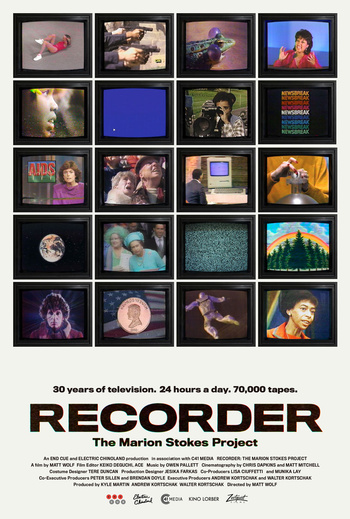
Recorder: The Marion Stokes Project is out on all digital platforms from 6th November 2020
This documentary by Matt Wolf examines the life of Marion Stokes, a woman who recorded television 24 hours a day everyday from 1975 until her death in 2012.
While this starts as a document about a life unknown outside of the Philadelphia region, Stokes is a trailblazer, a follower of a trend. The film slowly morphs into a document about how America has become desensitised in it's viewing habits with cable news becoming the mouthpiece for a nation.
From the Iranian hostage crisis in 1980 with the prisoners released on the day of Reagan's inauguration to 9/11 and the response time of networks to a tragedy that would hit them all.
The first half takes it upon itself to explain Marion Stokes' background, her flirtation with the Communist party and the possibility of a move to Cuba which was then jettisoned when common sense took over. Marion would appear on regional television in think piece shows where people of intellect would discuss topics at great length from racism, socialism, voter rights and so on. It was on this show that she met her future husband, John Stokes, a man who would give her a bigger world view, travelling to Europe - a place she only ever dreamed of in books.
Marion was forthright, stubborn, belligerent and this had an effect on the relationship she had with her son, a man who grew up to not obtain as great an intellect as hers, which she freely admitted. Yet Marion would read voraciously, books, a dozen newspapers everyday and started recording her news in 1975 but it really came to ahead in 1979 when the American hostage crisis in Iran took place, she started watching and was struck by how the narrative altered from the outset and throughout the long process. She noticed the point that the narrative would alter from day to day, like a long-running television drama series, combustible storylines, complex characters and altering narrative. Marion and the news networks realised they had a hit on their hands, by making news the star of daily night-time schedules the networks could create the narrative and status quo - the art of fearmongering came front and centre.

The hostage crisis took place in 1979 and into 1980 followed by the Soviet-Afghanistan conflict which prompted the USA boycotting the Moscow Summer Olympics. It also coincided with the birth of CNN in 1980 and the birth of 24/7 news coverage for the beginning of a new decade and new Presidency, under Ronald Reagan. An administration who knew how the media was as important as the bills passed to meld the public into their wishes of unknowing subordinates.
Marion was also a visionary, someone who was aware of trends in technology and media, able to see what companies were going places prompting her to urge her husband's board to invest in the early infancy of Apple and Steve Jobs at just $7 a share to begin with. This foresight led to great riches for the rest of her life.
Soon though, the recording prompted a reclusive nature to come to the fore, Marion becoming an obsessive and a collector, the film makes it clear that she is not a hoarder, despite having nine flats to keep hold of all the VHS tapes she and her husband had.
The second half of the film follows this tale of isolation, the watching of news and how Marion in effect become the first couch potato of the late 20th century, digesting daily news and noting how the big stories of the day and relevant time would be crafted by news agencies - the most important facet was that of racism in news media; black crime but most importantly, crime upon black people by authority figures especially police such as the Rodney King assault and the following riots across Los Angeles.
Marion's husband passed away in the latter half of the first decade of the 21st century and this took a toll on her as she had lost her soul-mate, yet the recording did not stop by Marion nor her devoted staff. The only problem posed as years went by was how technologies changed with the advent of digital media in more households it became harder and harder to source VHS tapes themselves in the greater Philadelphia area.
Following her death, the videos stopped recording and her son, struggled with how best to carry on her legacy and after 18 months of worrying, the Digital Institute in San Francisco took the bold step of buying all the VHS tapes, all 30,000 tapes in their entirety shipping them off to the West Coast, the intention to digitise all of them and then archive them into a digital storage available online.
The idea being that many local stations - those that Marion recorded - did themselves not have their own archive owing to costs and storage logistics, but Marion had the first 32 years of CNN at her disposal and all of closed captioning, an invaluable tool and resource for those who want it. America loves television, and this is evidence again - for social anthropologists, historians and media scholars, the digital library Marion's tapes provide will be an unbelievable look into the history of America through a lense.
Recorder: The Marion Stokes Project is released by Violet Pictures in 6th November 2020.
While this starts as a document about a life unknown outside of the Philadelphia region, Stokes is a trailblazer, a follower of a trend. The film slowly morphs into a document about how America has become desensitised in it's viewing habits with cable news becoming the mouthpiece for a nation.
From the Iranian hostage crisis in 1980 with the prisoners released on the day of Reagan's inauguration to 9/11 and the response time of networks to a tragedy that would hit them all.
The first half takes it upon itself to explain Marion Stokes' background, her flirtation with the Communist party and the possibility of a move to Cuba which was then jettisoned when common sense took over. Marion would appear on regional television in think piece shows where people of intellect would discuss topics at great length from racism, socialism, voter rights and so on. It was on this show that she met her future husband, John Stokes, a man who would give her a bigger world view, travelling to Europe - a place she only ever dreamed of in books.
Marion was forthright, stubborn, belligerent and this had an effect on the relationship she had with her son, a man who grew up to not obtain as great an intellect as hers, which she freely admitted. Yet Marion would read voraciously, books, a dozen newspapers everyday and started recording her news in 1975 but it really came to ahead in 1979 when the American hostage crisis in Iran took place, she started watching and was struck by how the narrative altered from the outset and throughout the long process. She noticed the point that the narrative would alter from day to day, like a long-running television drama series, combustible storylines, complex characters and altering narrative. Marion and the news networks realised they had a hit on their hands, by making news the star of daily night-time schedules the networks could create the narrative and status quo - the art of fearmongering came front and centre.
The hostage crisis took place in 1979 and into 1980 followed by the Soviet-Afghanistan conflict which prompted the USA boycotting the Moscow Summer Olympics. It also coincided with the birth of CNN in 1980 and the birth of 24/7 news coverage for the beginning of a new decade and new Presidency, under Ronald Reagan. An administration who knew how the media was as important as the bills passed to meld the public into their wishes of unknowing subordinates.
Marion was also a visionary, someone who was aware of trends in technology and media, able to see what companies were going places prompting her to urge her husband's board to invest in the early infancy of Apple and Steve Jobs at just $7 a share to begin with. This foresight led to great riches for the rest of her life.
Soon though, the recording prompted a reclusive nature to come to the fore, Marion becoming an obsessive and a collector, the film makes it clear that she is not a hoarder, despite having nine flats to keep hold of all the VHS tapes she and her husband had.
The second half of the film follows this tale of isolation, the watching of news and how Marion in effect become the first couch potato of the late 20th century, digesting daily news and noting how the big stories of the day and relevant time would be crafted by news agencies - the most important facet was that of racism in news media; black crime but most importantly, crime upon black people by authority figures especially police such as the Rodney King assault and the following riots across Los Angeles.
 |
| Director, Matt Wolf |
Marion's husband passed away in the latter half of the first decade of the 21st century and this took a toll on her as she had lost her soul-mate, yet the recording did not stop by Marion nor her devoted staff. The only problem posed as years went by was how technologies changed with the advent of digital media in more households it became harder and harder to source VHS tapes themselves in the greater Philadelphia area.
Following her death, the videos stopped recording and her son, struggled with how best to carry on her legacy and after 18 months of worrying, the Digital Institute in San Francisco took the bold step of buying all the VHS tapes, all 30,000 tapes in their entirety shipping them off to the West Coast, the intention to digitise all of them and then archive them into a digital storage available online.
The idea being that many local stations - those that Marion recorded - did themselves not have their own archive owing to costs and storage logistics, but Marion had the first 32 years of CNN at her disposal and all of closed captioning, an invaluable tool and resource for those who want it. America loves television, and this is evidence again - for social anthropologists, historians and media scholars, the digital library Marion's tapes provide will be an unbelievable look into the history of America through a lense.
Recorder: The Marion Stokes Project is released by Violet Pictures in 6th November 2020.

