Showing posts with label England football. Show all posts

Monday, 13 November 2017

Out of the Shadows


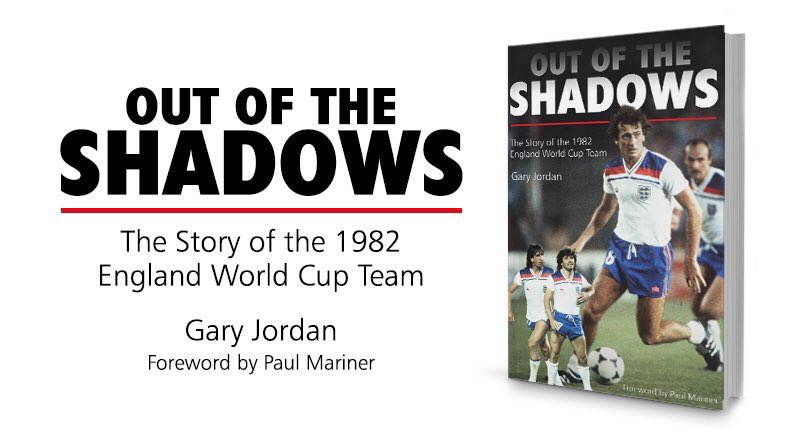
Gary Jordan, a freelance journalist, has written a fan's perspective and history of the 1982 England World Cup side that despite being one of the best accumulation of talent failed to progress beyond the convoluted second round where two 0-0 draws eliminated a team that won its first three games confidently.

Harking back to the 1970 quarter final defeat by West Germany which was the end of that generation's playing time together and the end of international careers of Bobby Charlton and Martin Peters. Jordan makes pit stops at the terrible mid-1970s when England failed to qualify for two consecutive World Cup finals due to a mixture of being unable to change with the times and selection issues off the field as well as on it.

Image result for 1982 World Cup England ron greenwood
Ron Greenwood - England manager 1977-1982

Jordan does investigate and explain how England side-stepped Brian Clough twice; initially for his nemesis Don Revie and then the FA darling, Ron Greenwood.  However, the reason England stumbled throughout the 1970s was more a fact to an inflated ego and self-importance of the Football Association following the glory of 1966.  England felt they were the best in the world, yet they did not follow it up despite playing so admirably in Mexico 1970; tactical naivety led to Alf Ramsey substituting Bobby Charlton when 2-0 up prompting a West German fightback which England could not prevent.

Image result for 1982 World Cup England
The 1982 England World Cup Squad

Ramsey got too long in the tooth by 1973 when Poland denied England at Wembley, and Revie could not do much better in attempting to qualify for Argentina in 1978.  Revie promptly left England for the oil money of the Middle East leaving England as poison chalice for whomever took charge.

Greenwood comes across as an esteemable figure, lauded by his peers and hugely admired by his players who got the best out of youngsters and was able to combine experience and youth in a dynamic package.  Whilst he had the veterans of Kevin Keegan, Trevor Brooking and Phil Thompson, he equally relied on the brash Bryan Robson, Ray Wilkins and Terry Butcher who would all become mainstays for the next four years.

However, Greenwood still succumb to problems that regularly beset England managers at major tournaments - think of the crippling metatarsals to David Beckham and Michael Owen, for Greenwood it was the lower back injury to Kevin Keegan who did not seek help from a respected German doctor until it was too late; and then tactical downfalls and second guessing. England needing to win the second second round group game versus Spain decided to play tactically and wait for an opportunity to win rather than go for the 'jugular' as Terry Butcher suggests, leaving the calvary of Keegan/Brooking only 26 minutes to save the day.  Greenwood admits he was damned if he did and damned if he did not but the chance of glory should not be passed up.

Image result for 1982 World Cup England
Kevin Keegan - injury cost him a starting place

These are familiar pitfalls for all England managers and Gareth Southgate may well encounter these before Russia next summer but ultimately when you have a class of player at your disposal you should not pass it up, and while Southgate is attempting to incorporate youth in with mainstays, the foundation of any campaign requires goals. If you cannot score goals, you cannot win games.

The book is a nice read from Gary Jordan, short sharp chapters that recall the matches fondly bringing in all manner of cultural resonance from the Falklands War to the searing heat of Spanish summers which led to Paul Mariner losing a stone in weight wearing a heavy polyester kit during the opening France game.

Written with passion and fondness for a by-gone pre-1992 Premier League era, Jordan has written a great tome to a team that though full of talent is regularly forgotten about in the shadow of our recall.

Out of the Shadows is out now from Pitch Publishing.

You can follow Gary Jordan on Twitter, he is sports features writer for The American, a magazine aimed at Ex-Pats in England


Monday, 3 June 2013

The Future's Oxlade

England drew valiantly with Brazil 2-2 in the Maracana Stadium in Rio last night, and no doubt would have lost on penalties if this was a tournament match-up.

However, following on from the drab encounter against the Republic of Ireland last Wednesday, England came away with some much needed credit to their name after being described as going backwards as they stuck to a 4-4-2 formation.

In this day and age of fluency and flexibility, the requirement of players and coaches to adapt to in game changes must be prevalent and the need of utility and adaptability is paramount from all concerned.  Players need to have many strings to their bow and not just be very good at one facet of play.

Roy Hodgson should be applauded as well for going for broke in Brazil, with the Samba stars taking the lead  through Hulk, many expected either Brazil to push their advantage home or for England to wilt in the stifling conditions.

Yet the England manager decided to be bold and took the initiative substituting Glen Johnson for Alex Oxlade-Chamberlain of Arsenal, this allowed Phil Jones to revert to his more familiar right back position having been a part of England's three man midfield - along with Michael Carrick and Frank Lampard - and struggling to maintain possession.

This allowed Oxlade to play his preferred central position behind Wayne Rooney with James Milner and Theo Walcott threatening from the wings.

Oxlade was exceptional in his brief time on the field, he played with passion, a desire to get the ball and distribute it keenly and with intent to those around him.  Rooney appreciated this play to feet as for much of the first half - link play was disrupted by Walcott's wasteful possession and poor decision making.  Oxlade's injection of confidence to a flat-lining team paid dividends with him scoring his first international goal away from home, a crisply struck drive through a sea of players that left Julio Cesar no chance to thwart.

Oxlade's influence of counter-attacking had a hand in England's second goal scored by Wayne Rooney with a slight deflection - crisp quick passing from a Brazil corner led to link up between Walcott to Milner to Oxlade who freed Rooney to run with the ball and curl in a shot that with the deflection escaped Cesar for a quick turnaround lead.

England's lacklustre defence however, could not keep Brazil at bay and parity was restored when Paulinho converted a half-volley unmarked past Joe Hart, whose first half performance deserved more as he kept a rampant Brazil led by new Barcelona signing, Neymar and Chelsea's Oscar at bay with some fine saves and brave blocks.

Whilst this performance as a whole did not warrant a victory, it did give us a glimpse of England when let off the leash - an attacking threat which with the right personnel can be impressive and ask questions of any team, although this Brazil side is not the greatest vintage as they are going through changes themselves in preparation of hosting the World Cup next summer.

Call it is his lack of experience or perhaps the innocence of his play, but Oxlade-Chamberlain is a breathe of fresh air compared to his club-mate Theo Walcott who is a frustrating blend of expectation and a lot of overblown hyperbole.  Walcott has pace and speed to burn and yet unlike contemporaries Aaron Lennon and Gareth Bale, he seems unable to run with the ball at this feet nor be able to make a decision that does not involve shooting at goal.

If Lennon had not picked up another injury it was likely that based on his overall level of performance could have started one of these internationals, Lennon's final ball and delivery is vastly ahead of Walcott's yet Lennon does not have the shooting boots Walcott has something that is most helpful in an international tournament.  With Michael Owen retiring due to a series of hamstring injuries that caused him to slow down and end with a career somewhat unfulfilled, perhaps Walcott should take advantage of his potential now before his first serious injury causes him to slow down and burn out.

Whereas in numerous international appearances, Oxlade has shown himself to not be over-awed by the occasion and looks like the sort of individual who after another season in the battle of the Premier League will become a better player.

Albeit by this time next year as Hodgson runs the rule over his final 23 for the World Cup (should England qualify -fingers crossed), Oxlade will not be a secret weapon but nevertheless be the sort of player who can make an impact coming off the bench.

And in this age of rampant commercialism amongst football, pardon me if I use a pun.  For England, the future is bright, the future's Oxlade.

Tuesday, 6 November 2012

Thoughts on Mark Hughes

When you have two teams in early November who have not yet won a League game play each other, you think one side will take the bull by the horns and win the game given the opposition is as bad as you have been.

Watching the QPR game on Sunday afternoon however, you had two sides who have forgotten how to win a game.  Not without trying though, Reading were given a 4 goal head start against Arsenal during a League Cup tie and yet they failed to see the game out losing 7-5 in extra time.

Yet Reading have played some good stuff, they are full of tenacious individuals who you feel would throw themselves under the bus for Brian McDermott, who is not in a position of untenable pressure.  The expectations at Reading are more realistic than the tenants of Loftus Road.

For some reason, the owner of QPR, Tony Fernandes believes that the Hoops can be the next big noise in London and on a European stage.  Yet this is a side who four years ago were in the Championship - sacking managers left right and centre and until Neil Warnock was employed did the side get the much needed stability and eventual Championship title triumph resulting in a return to the Premier League.

In the first season back QPR suffered with these expectations, Warnock was deemed to be surplus to requirements.  Adel Taarabt who was talismanic during the the title campaign, was found out by Premier League's better defences and his own attitude problems did not help.

Now QPR have had a revolving door policy to talent, if we can find someone who is available and on paper you will be replaced.  Robert Green left West Ham hoping for a more lucrative contract, which he was given, yet is now warming the bench due to the signing of Julio Cesar from Inter Milan.  Tough choice to pick between a Champions League winner or an England international flop, although Cesar has been anything but solid lately, twice flapping at crosses/shots that led to conceding crucial goals.

However, for me the problem stems with the management.  Mark Hughes is the atypical mercenary manager, he has never stuck out a job.  His longest job was his first, when he managed Wales during 1999-2004 and nearly led them to qualifying for a major tournament for the first time since 1958 when he managed such talent as Ryan Giggs, Craig Bellamy, Robbie Savage yet he did not see them through.

Next was Blackburn Rovers where he led them to their best Premier League finish of 7th in 2007-08 (a position they have never returned to), and yet here was the first inklings of people's impression of Hughes changing. Every season he was in charge at Ewood Park, Rovers finished bottom of the fair play league.  A position QPR are sitting in now, as they have a player sent off every other game.  The red card away at Arsenal cost them a point, although Hughes is always quick to blame the referee.  When neutral observers would state that when you are bottom the rub of the green is never there for you.

Hughes left Blackburn for Manchester City during the summer of 2008 and was in charge until December 2009, when he was sacked for Roberto Mancini.  Hughes was in place when the money from the Saudis arrived and he signed players who are very much the spine of Mancini's side - Gareth Barry, Carlos Tevez, Joleon Lescott and he made the decision to start Joe Hart over Shay Given.  So perhaps the most influence Hughes has had is over another side to this day.

Next he joined Fulham in July 2010 after seven months of unemployment, he left Fulham after just one season although he gained them European qualification saying he wanted to further his experience. This upset Mohammed Al-Fayed, who judged Hughes to be a flop and a strange man.

The judgement of Hughes' managerial style is the same accusation that was levelled at Glenn Hoddle, a brilliantly gifted footballing individual capable of anything on the football field in terms of skill and invention; yet he is unable to shepherd similar youthful talent.  Remember QPR were very nearly relegated at the end of last season, even though they were sitting somewhat comfortably when Hughes replaced Warnock in January of this year.

The inability to communicate with players leads to a manager signing too many players, unable to get consistency in terms of selection and performance from his side.  You can imagine Hughes becoming bullish and frustrated with his players who are unable to fulfil the simplest tasks, remember the stories of Hoddle showing off his ability to pinpoint passes of 60 yards onto someone's toe or scoring ridiculous free-kicks.

Hughes own personal ability and ambition has never been in doubt, yet his unique way of communicating or lack thereof renders his head definitely on the block and probably two or three games away from the billionaire owner losing his patience and getting a better, more high profile manager in.  Hughes joined QPR because the money was good, and the players would sign for big pay cheques.  Maybe he is learning that it is hard to motivate lesser than good players who are being paid handsomely.

Monday, 25 June 2012

England v Italy review

So once again, lady luck proves to not be an England fan as Roy Hodgson becomes the latest England manager to succumb to the dreaded penalty shootout.

England lost 4-2 on penalties after 120 minutes of stalemate football, as England struggled to create chances against a strict Italian defence led by the mighty Gianluigi Buffon in goal.  England were thankful themselves for the continued form of Joe Hart in goal, as he kept at bay his club team-mate, Mario Balotelli and the engineer Andrea Pirlo who was unanimous as man of the match.

Pirlo dictated the pace of the game, able to pull the strings and orchestrate the action at a pace he suited in his advancing years.  He was helped by the fact that he had two midfielders along side him, this meant that Steven Gerrard and Scott Parker were outnumbered in midfield allowing Pirlo a total freedom of the Kiev pitch.

Yet England looked lacking in ideas and originality, unable to create anything, not getting anything from the wide men, relying on set pieces to count as attacking opportunities.  So where did we go wrong?

1. Wayne Rooney failed to step up
Whilst it would be unfair to single out one man for England's defeat on a shootout, Rooney was expected to return to the England side full of vigour and intensity following his two match suspension.  He can be forgiven for ring rust in the first game against Ukraine, in which he scored, yet his anonymity for much of the two hours of football cannot be.  Rooney was in his fourth tournament, and yet it still feels that he has been unable to replicate good club form to an international platform.

2. Injuries ruined England's gameplan
The dual injuries to Frank Lampard and Gareth Barry denied England the opportunity to fully employ Roy Hodgson's gameplan of flooding the midfield.  If Barry had been fit, he would have joined Gerrard and Parker in the centre able to combat the three man Italian midfield, and also allow Gerrard to support the front pair more often; something missing from the game.  Too often Young and Rooney were isolated with lack of support runners.  Lampard's form for Chelsea at the end of the season was mightily impressive with his mix of stern defence, tackling and bombing runs into the box.  Lampard would also have been a definite penalty taker last night.  Barry and Lampard's presence would have allowed the opportunity to rotate and rest Parker's ailing ankle ligaments; the fact that Jordan Henderson was his substitute spoke volumes.  The introduction of the Liverpool player at the bar where I watched the game, was met with a mixture of 'Oh no not him' and sighs

3. England need creativity
England were seemingly hoping to soak up the pressure from Italy, and possibly counter them on the break with the pace of Young and Welbeck.  Yet too often the final ball was poor and by the end England were hoofing the ball from Hart to Andy Carroll, a good ploy has Carroll won plenty of ball but had no options when he gained possession.  England need a player with a creative streak in him like Paul Gascoigne or Glenn Hoddle,someone who can run at people with the ball from midfield with an air of fearlessness whilst being assured, sadly that player was also one who was injured, Jack Wilshere.

4. Defence is key
Hodgson in his six games thus far has had four clean sheets; he has a pedigree of sorting out this problem.  He was helped by having a Championship winning keeper defender combination in Hart and Joleon Lescott, two Champions League winners in John Terry and Ashley Cole, and the reliable Glen Johnson who has grown in this tournament.  It would have been interesting if Kyle Walker had been fit what impact his darting runs down the right would have made.  Yet with Terry in the twilight of his years and pace alluding him, England have backups in Gary Cahill, Phil Jagielka, Michael Dawson and Phil Jones.  Thankfully also they have a world class goalkeeper for the next 10 years.

5. The FA picked wisely
The FA should be pleased with their appointment of Hodgson over Harry Redknapp, Hodgson did what was expected of him by getting England out of a difficult group.  He showed some tactical acumen as you would expect but also got a rub of some green and allowed the squad to display some harmony and unity from a press that were not expecting the world. You imagine if Redknapp was in charge, the gameplan would have been more gung-ho which can lead to it blowing back in your face.
Hodgson has laid the groundwork, now in conjunction with the FA and the new St.Georges Park complex opening in Burton; the head coach must have a say on what must be done technically to improve England in terms of ball retention, possession and ball retrieval.  At times Italy had three people swarming over Ashley Young to win the ball back; this is something Spain do effectively also.

Next for England is the qualification for Brazil 2014 in Group H involving Ukraine, Poland, Montenegro Moldova and San Marino. Whilst we should qualify as group winners and worst make a play-off, the away trips will be a big test of character for much of the squad.  Whilst we will not win the World Cup, and no European team has ever won a World Cup when it has been held in the Southern Hemisphere (you can include both Mexico World Cups in that also); the omens may not look good but then they did not four weeks ago.  Roy did the best he could do and so he should be applauded for that, having served himself with such distinction and class thus far.

Tuesday, 1 May 2012

Harry or Hodgson

The news that on Sunday (29th April), the Football Association (FA) made an approach to West Bromich Albion to begin talks with their manager, Roy Hodgson about the vacant position of England manager came as some sort of surprise to many.  Even more so when it became knowledge that Hodgson was the only manager that they have approached.  This means that the FA will be holding no talks with any other available manager, most prominently Harry Redknapp, the bookmakers favourite and People's Choice for the role this summer at the European Championships.

Hodgson is a vastly experienced manager, in world football and with esteemed clubs across Europe.  Hodgson took a limited Switzerland side to the 1994 World Cup in USA where they made the first knockout round, beyond expectations.

It seems that Hodgson works against this brief at every club.  Exceed expectations.  At Fulham, he took the team to the Europa League final, most notably defeating Juventus 4-1 at home to win on aggregate; before they lost to a very good Atletico Madrid starring Diego Forlan in the final.  This came a season after he saved the club with a last day escape at Portsmouth. Yet this journey to that final gave Hodgson some cache and was given the chance at a big club in England, having previously managed Inter Milan in Italy.

Liverpool came a calling and Hodgson understandably jumped at the opportunity, much like he will with the England job, yet Liverpool turned into a poisoned chalice of a job.  Hodgson struggled to gain rewards through his tactics and vision, there were chants from the crowds of boring football and a series of bad results ending with a home defeat to Wolves in early January 2011 led to the guillotine being dropped on Roy as he headed for the hills.

During a new takeover of the club by the Fenway group, Roy did not fit the bill as the head coach who installed Kop legend, Kenny Dalglish, as manager for the remainder of the season.  The new owners opened their chequebook for Dalglish, something they failed to for Hodgson who signed Joe Cole, a player who failed to impress or fit into the system behind Fernando Torres and in front of Steven Gerrard.

After Hodgson's departure, new signing Luis Suarez and Andy Carroll arrived in the January transfer window; then Jose Enrique, Stewart Downing and Jordan Henderson in the summer.  Hodgson could have benefited from such signings, yet his pedigree deserved longer than 6 months in charge at a big job.

He shortly returned to management landing with the baggies in West Bromich Albion; a team he resuscitated surviving a nervy relegation battle with games to spare.  A solid summer signing players who work hard and gaining more out of players has led to a solid season, that will avoid the threat of relegation easily without moving up.  That must be a target for the club to break the top 10 next season, of course it would need Hodgson to remain at the Hawthorns, something that looks unlikely.

So why has Hodgson being picked over Redknapp?  A lot has been made of Redknapp's trial in early January for tax evasion, for which he was acquited from.  Since then and following Fabio Capello's resignation, it was expected that Redknapp would be told the England job was his come the end of the season.

Yet the FA have played the waiting game to see how both managers have fared.  In early January, Tottenham were knocking on the door of a title race, and looking assured in 3rd place 11 points clear of Arsenal.  Yet a disastrous last hour of the game away at Arsenal, going from 2-0 up to 5-2 down led to defeats against Manchester United, Everton and further dropped points away to Chelsea and Sunderland, and a crippling home defeat to Norwich.  Tottenham are battling for 4th now, they are ahead of Newcastle on goal difference, yet have an easier run-in with three winnable games - Bolton (A), Villa (A) and Fulham (H) - compared to the Toon Army who have to travel to Chelsea and play champions elect, Manchester City at home.

Yet the poor run of results for Tottenham following a 5-0 home victory over Newcastle, resulted in one win (Swansea 3-1 at home) in 9 games showed a bit of naivety on Redknapp's behalf.  For most of the season, he has an idea of a starting XI who have played or started most of the season.  In this day and age of quicker more intense play, the team could have done with squad rotation yet unfortunate injuries to Michael Dawson, Tom Huddlestone and always niggled Aaron Lennon, has led to few players getting rest when it could have been afforded.  Also the requirement to give Ledley King a week off between games has actually  been counter-productive for continuity as King has actually looked slower this season than ever before as he fights father time.
Redknapp also let several squad players depart - Vedrun Corluka and Steven Pienaar left on loan to Dortmund and Everton respectively, yet Pienaar would have had a good run following Lennon's hamstring and his form at Everton has helped that side end the season in formidable form, assisting and scoring goals.  For Everton, Pienaar replaced Landon Donovan effortlessly.
Redknapp also trusts the starting XI too much failing to make substitutions or leaving them too late for any player to make an impact; also the lack of impact off the bench (sorry Jermain Defoe) might make this a mute point.
He has also not been helped by players such as Luka Modric and Gareth Bale not living up to their own standards or thinking about next season's employment.  It goes without saying that if Tottenham fail to get Champions League football, those two players will depart.

Yet Redknapp also has too much of a personality for the job, of course he has a good relationship with the press but can he deal with the pressure of a whole nation.  In a knockout tournament, his tactics might get found out quickly, and he has to be able to keep a lot of egos happy in one dressing room.  Whilst the players may respect Redknapp, there is a difference between appreciating a man and listening to him.

Hodgson may garner as much respect, but he has a bit more tactical nous about him in relation to how other nations play football; England need a tactical mastermind for the European championships, not a cheerleader.