Showing posts with label english soccer. Show all posts

Friday, 15 December 2017

Stubborn, Tense, Boring - English football on a Wednesday night

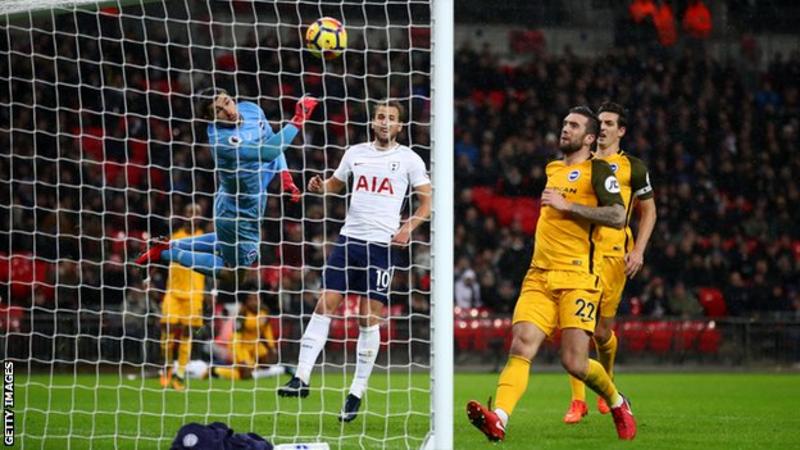
Having had the pleasure to go to Wembley Stadium, it might be a ball-ache to get to, but it is still Wem-ber-lee; to watch Tottenham Hotspur defeat Brighton 2-0 in the Premier League. It became quite apparent that there is a shifting between the top teams when they play at home versus the supposedly weaker teams of the division.

Serge Aurier (in the background, on the floor) scores for Tottenham

Tottenham especially have found it hard to break down disciplined defences at home on a wider pitch, coupled by a change in personnel and teams taking the calculated risk of defending for long stretches and hopefully be clinical in the final third should they ever reach it.

Dropped points at home to Burnley, West Brom and Swansea meant that Brighton followed the same song sheet; defend in two lines of four in defence and five in midfield with one lone striker running around forlornly.

Tottenham however seemed to play into their hands, perhaps a level of complacency, but also the re-introduction of Erik Lamela into the side following a long injury lay-off. What is most perplexing is that the Argentinian is a dominant left-footed player yet he drifts to the right hand side of the field, forcing him to stop and then cross allowing defenders to be ready to intercept passes by feet or head.

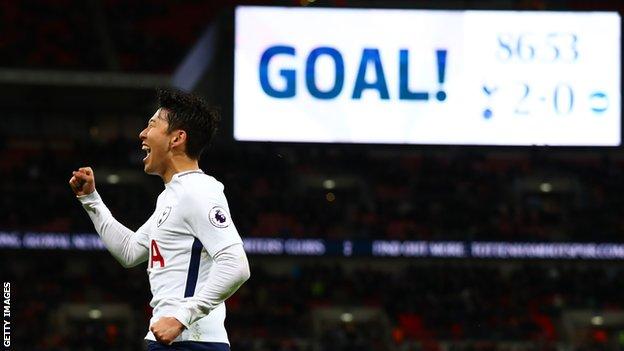
Son Heung-min

Son played with his usual zest running into channels but too often the team wanted and got the ball played to feet, not allowing pace in behind forcing defenders to turn and lumber into bad decision making.

Another surprise was the immobility of Harry Kane, who made little runs off the ball forcing midfielders - Harry Winks especially - to pass the ball continually sideways. The pace of Trippier might have unlocked the wing, and the team were slow to respond to the weakness of Brighton right-back Schelotto who showed little in the way of deftness and plenty of lead foot when up against Son and Rose down the left wing.

The lack of originality and imagination in breaking down a stubborn defence was indicative of the aural response to another backwards pass by Winks when there was space for him to move forward into and threaten the final third.

Image result for harry winks

Is this a fear of making a mistake or a fear of taking responsibility? Once Winks was substituted for Dembele, there was an impetus within the side, seconded when Dele Alli arrived for a short 15 minute cameo which provided some drive.

Spurs appear to be a better side on the counter attack and soak up pressure themselves which is something they may well do versus Manchester City on Saturday night; however, there is a worry of this defence being able to sustain the constant barrage of City offence. The match should allow the opportunity to play in gaps between the defence and midfield with the ball at the feet of gifted players.

Tottenham will continue to have this problem, the first Premier League game at Wembley in the New Year will be West Ham; a team that soaked up Arsenal on Wednesday night followed by Everton and Sam Allardyce who did a number on Jurgen Klopp's Liverpool last weekend.


Image result for chris hughton

Yet Tottenham must come up with an answer to breaking down these stern defences if they want to maintain a Top four challenge whilst City runaway with the title. My worry is that Tottenham were boring on Wednesday night, although Brighton were frustrating in that they were two goals down in injury time away from home and they allowed Tottenham to pass to their hearts content and settle to concede no further. This is indicative of football in this day and age; West Brom away at Liverpool, Bournemouth at Manchester United all settling before the game plays out for a best case scenario of no goals and one point.

Sunday, 20 November 2016

Striker or Forward?


I have a question, I need to ask somebody. What is the difference between a striker and a forward, a centre forward by its greater catergorisation?

striker
ˈstrʌɪkə/
noun
  1. 2.
    the player who is to strike the ball in a game; a player considered in terms of ability to strike the ball.
    "a gifted striker of the ball"

forward
ˈfɔːwəd/
adverb
  1. 1.
    in the direction that one is facing or travelling; towards the front.
    "he started up the engine and the car moved forward"
    synonyms:ahead, forwards, onwards, onwardonfurther
    "the traffic moved slowly forward"
adjective
  1. 1.
    directed or facing towards the front or the direction that one is facing or travelling.
    "forward flight"

noun
  1. 1.
    an attacking player in football, hockey, or other sports.


These are the Oxford English dictionary definitions of the two terms. Football throughout its history is defined by the goals scored and the players who score them. Goalscorers are widely lauded and more fondly remembered in the annals of football; the Ballon d'Or (FIFA World Player of the Year) has been won by defenders and goalkeepers on only three occasions (Yashin, Sammer, Cannavaro).

The reason I want to ask this question is because of the way pundits and commentators refer to them during a game and in analysis. How would you describe someone like Diego Costa? Is he the same sort of player as Harry Kane? How would you differ between the categorisation of Lionel Messi and Cristiano Ronaldo?


This writer is hopeful that there is a way of distinguishing between the two based on the role in certain formations and the tactics employed by various managers throughout the years.  For instance, I would categorise Ronaldo as a striker, one who is able to strike the ball well and scores goals. Messi therefore would be construed as a forward, he plays in the direction of the goal and is an attacking player; because he receives the ball some distance from the opponents goal and he travels towards it. Ronaldo, meanwhile, strikes the ball when he is near the goal making his late runs into the box and awaiting assists from his team-mates.


This is not an essay to say which one of those two amazing individuals is better than the other, that debate has gone on for far too long and they both are worthy of the praise they constantly receive with their place assured in the historical annals of the game.

My query is more so on how the positioning of these forward players is slowly changing as tactical mindsets alter in an ever changing football climate.


To go back to my earlier examples, Diego Costa by my definition would be a forward in both the current definition of an attacking player but also the forward in the mindset of British football as that strong individual who would lead the line up front, hold the ball up so supporting runners can join in the attack, distribute the ball to flying wingers much in the same vein as an Alan Shearer did do.


Harry Kane, meanwhile, is a striker in the vein that he is able of striking the ball well but fundamentally scores goals at a good conversion rate, able to score all manner of goals in differing varieties such as headers, curling shots, powerful drives much like Gary Lineker did or his current contemporary Sergio Aguero can.

By my reckoning, a striker is the one who scores goals regularly and a forward is the number 9 who assists the number 10 in scoring more than him.  Think of Mike Newell/Chris Sutton assisting Shearer at Blackburn or Peter Beardsley assisting Andy Cole at Newcastle United; all three players scored their fair few of goals but less than the striker.


A better example is probably the forward Niall Quinn playing in tandem with Kevin Phillips during his phenomenal 30 goal season in the 1999-2000 season, Quinn had 14 goals himself. That was the end of a three year partnership where Phillips scored 82 goals in 105 games, a ratio of 0.78 per game. That is a rate up there with the best of current prolific forwards such as Aguero and Kane.

So can we distinguish between a forward and striker so easily based on the number of goals they score, when you have the battle between Messi and Ronaldo going on and on, goal for goal? It may never be a clear distinction between the two but perhaps it is open for a longer and more thorough examination.

Thursday, 13 June 2013

The Gaffer - Book review

Released in time for Father's Day, Neil Warnock has released a book entitled The Gaffer: The Trials and Tribulations of a Football Manager.

The book which can be considered Warnock's first public statement since he departed Leeds United is a look back on his career throughout football via the big moments of his career from guiding Sheffield United to the Premier League, to the fall-out of being relegated and the ensuing Carlos Tevez saga which ultimately cost him his job.

Focusing primarily on the time at his QPR and the money involved with the club, Warnock is keen to stress he holds no ill will towards the owners who sacked him but would be more inclined to focus on the privilege in guiding the club from near relegation the previous season to table toppers helped by such talent as Adel Taarabt, Heidar Helguson and Jamie Mackie.

Warnock's tone throughout the book (helped by Glenn Moore of the Independent; for whom Warnock wrote a weekly column which was as entertaining as this title) is one of eternal optimism, you get the sense that Warnock loves doing the job he does, and for every job he loses due to poor form or new owners, he is reflective on the job he has done has been to the best of his abilities.

Warnock comes from the same school as Harry Redknapp - not the greatest of players during the playing career but a man who has a keen observation of tactical formation and man-management. Warnock mentions how he used speed of his youth team at Crystal Palace to good effect prompting the promotion of John Bostock and Nathaniel Clyne amongst others to the senior side; Warnock set the framework by which Palace continue with Wilfred Zaha at the forefront of Palace's promotion season.  Warnock's belief was that these youngsters need to play games before moving on to bigger clubs, where they will stagnate and plateau - a telling remark in light of England U21s disastrous European tournament.

This may be a view of one man on his life in football, and at times like most biographies it can be self-congratulatory yet Warnock's joie de vivre for life and football does come across mostly; his numerous famous interviews made him appear to be a man you would like to sit down with for a pint.  This book does not disappoint in that respect, and his chapter on refereeing standards is both enlightening and eye-opening.

The Gaffer is a perfect gift for Father's Day, for a no-nonsense account of life as a somewhat scapegoat in a business first approach to football.

The Gaffer is out now from Headline Publishers at £16.99 and is also available as an e-book.

www.headline.co.uk

Thursday, 23 May 2013

The Numbers Game - Book review

Following on from the trailblazing work of Moneyball which told the story of how Billy Beane, General Manager of the Oakland A's transformed the worst team in Major League Baseball into a viable contender, and after Soccernomics by Simon Kuper and Stefan Szymanski which indicated why England lose more often than win at major tournaments - comes a new book by English football loving, American scholars Chris Anderson and David Sally, entitled The Numbers Game: Why Everything You Know About Football Is Wrong.

Both Anderson and Sally's academic background is from the Ivy League schools of Cornell and Dartmouth respectively.  Anderson is an award winning social scientist and football analytics pioneer who consults with leading clubs, Sally is a former baseball pitcher for his alma mater of Harvard and analyses strategies and tactics people use.  In reading the book, it is clear that the men's love of the game of football or soccer is very evident.

Whilst the book does focus on number crunching, it attempts to dissuade the well praised myths of football such as those who believe Barcelona's tika-taka passing game is the be all and end all of current football theory.

As a self-professed football nut and lover of statistics this is the sort of book I digested in two sittings, as the theories soaked into my brain.  Anderson and Sally write with a genuine passion for the game, and are optimistic about the future of the game whilst making clear that football is a team sport and for all the genuine brilliance of a Lionel Messi, he is but a part of a team.  A favourite theory is the 'The O-ring theory of Economic Development' originally published by Michael Kremer at Harvard in 1993; they set the theory that one faulty or weak o-ring like the one that caused the Challenger Space Shuttle to explode in 1986 can be applied to top class football.

By saying that a faulty member can affect the performance of the team as a whole, clubs tend to pay out more on human capital.  They state the difference between Everton's Finch Farm training complex with 15 pitches, weight room, canteen in comparison to Walsall's three pitches, gym and you can see the picture.  Everton can pay for more scouts to watch more players, Walsall cannot.

Other favourite theories they found from their data supplied by amongst others ProZone and Opta Sports include that goals are not as common as we believe.  On average, a goal is scored every 69 minutes and 1-1 is the most common score - the most valuable goal for a team to score is the second goal as it can be directly translated to more points being garnered.  They also state that if you concede less you are more likely to gain more points, meaning that for all the money expunged on strikers the more valuable players may well be the defenders and goalkeepers to keep clean sheets.  Whilst you can score three goals you may not get three points, whilst conceding no goals is more likely to obtain three points.

Another one that may raise fans eyebrows who bemoan the lack of proactivity from managers may be the analysis that says managers should make their first substitution prior to the 58th minute, the second prior to the 73rd minute and third prior to the 79th minute.  Substitutions with 10 minutes remaining are statistically not effective, so when you see a manager still not making a change after an hour of play, the chances are your chances of turning around a deficit are diminishing.

Pleasingly for all their success the heroes of the book are not Manchester United, Barcelona or Chelsea but the smaller names of Wigan Athletic and Stoke City who have succeeded in the long term by changing their game style to suit their weaknesses; whilst Stoke may be derided by some for the way they play, yet Stoke as the figures show can win a game by passing less and utilising their ability to score from a direct form of play.

The book is a wonderful read for sport nuts and number nerds - it is a testament to the authors that the book reads so easily and can be digested with such ease in a manner that is neither patronising nor feel that you are being spoken down to with such a wealth of information.

THE NUMBERS GAME by Chris Anderson and David Sally is published by Viking Trade in Paperback on 30th May, priced £14.99 and is also available as an ebook across many suppliers.

Monday, 13 May 2013

Three of a Kind

With the impending retirement and final matches of three English stalwarts - Michael Owen, Paul Scholes and Jamie Carragher - it is time to reflect upon a hole in the English game as a veritable backbone of Association Football rides into the sunset.

These three men were of different positions, requiring different skill sets all calling it a day.  All three started their professional careers in their teenage years as products of prestigious academy programs and now retire rich men in their mid to late 30s. Football has given them everything they could imagine, three head now for very different career paths.

Michael Owen looks set to leave football altogether bar the odd studio guest appearance for a live match and follow in the footsteps of another famous England striker, Mike Channon, and focus on his stables as an owner and his ever booming property development.

Paul Scholes is the quiet man and looks set to maintain a long association with Manchester United in either a coaching capacity or an ambassadorial role.  Jamie Carragher immediately leaves the pitch to take on a punditry role like his namesake Mr Redknapp and old adversary, Gary Neville, working for Sky Sports although like Neville the door is open to a return to football as a coach.

Most significant about their retirements is that three very fit individuals have all succumbed to this new era of fast and fluid football, by ultimately slowing down.  They are the first victims of this continual conveyor belt of football, having to play in highly intense games week in and week out both on domestic and international fronts.  They are victims of their own success, by playing for prominent teams they had to play in four competitions throughout the season, regularly hitting 50 games a season (38 league and approximately 12 cup games).

This requirement to play at such a high level put a strain on the body and mind, and led to Paul Scholes retiring from international football after England were eliminated from Euro 2004.  Whilst a bold step it nonetheless prolonged Scholes' career as he retires for the second and final time some nine years later.

When Michael Owen burst onto the English football stage at Wimbledon for Liverpool, his game was all about pace and velocity, that burst of speed to go away from a defender that he left standing still.  Owen like Thierry Henry revolutionised the play of forwards, whose speed scared defenders.  Unfortunately, Owen through a series of hamstring injuries got slower as the years passed, he could still be a fox in the box but a series of injuries helped lose his mystery. As his hamstrings got tighter and shorter, the game and defenders got sharper and quicker.

It seems a shame that the memory of him gliding across the turf in St Etienne versus Argentina should come so young in his career and that the same career be one that was seemingly unfulfilled, we should be talking about goal figures akin to Jimmy Greaves, and yet we are closer to Frank Lampard.

Carragher is one of those defenders who like Gary Mabbutt and Mark Wright will forever be unheralded and underrated.  The admiration for Carragher comes from his ability to take what looks like a basic skill set and blossom into a fully fledged England international (38 caps) and the second most league appearances for Liverpool with 737 (should he play on Sunday afternoon) and 11 major honours.

Carragher is also that rare breed - like Scholes - of being part of the fabric of his hometown team.  The Liverpool vice-captain would rather call it a day than kick a ball in vain for another club, fittingly Carragher bleeds the red of Liverpool.  His stubborn self-belief, determination and pride were never more evident on that famous night in Istanbul in 2005 when his rearguard effort along with Jerzy Dudek in goal, were as inspirational as Steven Gerrard.  You can recall Carragher diving again to block another goal bound shot in the late stages of extra time when he just lay on the turf riddled with cramp, yet he would not ask for treatment for fear of leaving the field and conceding.

It seems a shame that Carragher retires with only 38 caps to his name, as he was a victim of being apart of a great class of defenders who were just that bit better than him due to height, ball control and domination of the aerial battle - Rio Ferdinand, John Terry, Ledley King and Sol Campbell.

Tellingly, this Sunday sees three names and former England internationals retire and another three from that great night in Munich on 1st September 2001 call it a night.  For Owen that was his best night of football, for Scholes it was another quiet impactful performance before Frank Lampard's goalscoring consistency led to Sven-Goran Eriksson question how to put three of Scholes, Lampard and Gerrard into two positions.  The laughable notion of asking Scholes to play left midfield probably sped up Scholes' retirement decision and although Carragher was an 83rd minutes substitution for Scholes he nevertheless was there and part of the team.

Memories and odes will be written for all these men by fans of them who are greater than myself, yet is it not surprising that all three men came through the youth ranks of Liverpool and Manchester United, for Scholes he was a part of the greatest youth team in living memory.  But is there not a lesson there for all these owners who pour money into the coffers of managers by buying in product from overseas, the talent is in this country and can be found if nurtured correctly.

Whilst Owen struggled to find a home and played for both Carragher and Scholes' one and only clubs, the way Carragher and Scholes have served their respective clubs with dignity, passion and their own unique brand of panache is worth its weight in gold, irrespective of the amount of silverware they have claimed.

Thursday, 21 March 2013

Will AVB stop tinkering?

Being a Tottenham fan myself, I do try to not write damning pieces about our side and reserve my judgement to a sobering reflection across a pint or two with similar fans.

Over two weeks ago, Tottenham won the North London derby at White Hart Lane against rivals Arsenal 2-1 thanks to two goals in three minutes from Gareth Bale and Aaron Lennon.  Although they held on to the three points thanks in part to a solid rearguard led by captain Michael Dawson and Jan Vertonghen playing at centre back - the warning signs were there in the first half against the Gunners.

Until Gareth Bale scored the opener, it could be argued the lead came against the run of play with Arsenal enjoying the majority of possession and territory in midfield, albeit without engineering many chances of note.  The trio of Jack Wilshere, Mikel Arteta and Santi Cazorla over ran the midfield duo of Scott Parker and Moussa Dembele of Tottenham, until Spurs engineered a sleek passing interchange which led to Bale's neat finish.  Two minutes later, a defence splitting pass by Parker met Lennon on a run where he rounded goalkeeper Wojech Sczezeny to give a two goal cushion.

However, with Tottenham things are never easy or as easy as they should be.  Having gained a 10 point lead over Arsenal, Tottenham should have been aiming to catch Manchester City in second place and yet in the last two league games away at Liverpool and home to Fulham, Tottenham have contrived to lose six points when at least four were there for the taking to cement their position in third place and secure Champions League football.

Leading 2-1 away at Anfield with 20 minutes remaining, Spurs conspired to snatch defeat from the jaws of victory thanks to two lobotomised moments of defending.  Kyle Walker suffering from 'second-album syndrome' played an ambitious across the pitch backpass that left Hugo Lloris somehow attempting to clear the ball, which he missed and Stewart Downing easily converted.  Then Jermain Defoe toe-ended and skied a clearance twenty-five yards from his goal back into the penalty area, landing at the feet of Luis Suarez who was fouled allowing Steven Gerrard to convert the winning spot-kick.

After giving up the lead, Spurs struggled to create any noteworthy chances.  Then they lost at home to Fulham, thanks to a winning goal by returning Dimitar Berbatov.  In this goal, Tottenham again failed to create chances and met Mark Schwarzer in inspirational form in the Fulham goal.

What was most striking about the Fulham defeat was the bizarre formation and team selection employed by Andre Villas-Boas.  Having just survived a Europa League tie at Inter Milan on Thursday night after extra time from a seemingly comfortable position (see how it is never easy for Spurs); AVB started five players who played the entire 120 minutes of the Inter game.  And then seemingly played a hot-potch of the best available players in an eleven seemingly there to go and get the job done before the international break.

AVB might have been responding to Arsenal's 2-0 win away at Swansea on Saturday afternoon, yet Spurs are the form team and yet played in response to the team Fulham played.

AVB played Steven Caulker at right back to probably nullify Damien Duff or the running of Giorgios Karagounis or Bryan Ruiz; whilst Dawson and Vertonghen could contend with Berbatov.  Then he played Kyle Naughton at left back with Benoit Assou-Ekotto at left wing.  This strikes you as bizarre given how Naughton's form this season has been less than impressive and he is predominantly right footed also the positioning of Ekotto at left wing left him rather exposed and wasted, is he meant to supply cover for the youngster or be an out and out wide threat which he is not.

Elsewhere, Parker and Dembele played in front of the back four with Bale and Sigurdsson behind Emanuel Adebayor who played up front on his own.  This left Tottenham shorn of creative wing play; whilst Bale has been on fire, he needs to play on the left wing to terrorise whichever poor soul is playing right back.  Yet the absence of him, has led many to suggest and correctly that Aaron Lennon has been more important to Tottenham's great undefeated streak than the Welshman.

Lennon has been playing better in recent months, yet again though he has succumb to a niggling injury and his invention on the right wing in parallel to Bale on the left had led to many chances being created.  On Sunday, the idea was seemingly give Bale the ball and something may happen, clearly something did not.  Tottenham were too narrow and constricted which played into the hands of Fulham whose midfield was marshalled by Steve Sidwell and Ashkan Dejagah whilst Sascha Reither bombed forward when possible on his right wing, his run and pass set up Berbatov's winner.

AVB must have felt that Fulham could be defeated by simply turning up, which is unfair to under-estimate a Fulham side whose away form whilst poor belies the football they try to play under Martin Jol - quick passing, counter-attacking which Tottenham allowed them to do in the first half which gained them confidence.

An observation aimed at AVB would be why play Adebayor whose still is even more laid back than Berbatov, but who looked even more lethargic on Sunday after having played two hours on Thursday.  Although he scored the vital away goal, his form has been woeful and Sunday demanded a start for Jermain Defoe who is coming back from injury.

Also, why has Lewis Holtby been used less and less in the Premier League yet more in the Europa League.  Holtby has the industry to unbreak many defences yet he was an unused substitute on Sunday (three strikers were brought on instead - Defoe, Thomas Carroll and Clint Dempsey) in search of an equaliser and played only six minutes as a substitute at Anfield, again in search of an equaliser.

The loss of Michael Dawson at half-time to a hamstring injury was unfortunate and led to Caulker joining Vertonghen in the centre, yet the substitute was Clint Dempsey. The correct change would have been move Naughton to right back, Ekotto back to his preferred left-back position, Bale to left wing, Sigurdssson to right wing and Holtby in behind Adebayor or Defoe, yet AVB felt more forward power would overcome Fulham; a hard task against a veteran backline of Hangeland, Senderos and Schwarzer.
Monday, 3 September 2012

Lamenting Liverpool

Liverpool FC are supposedly in crisis, they have one point from there first 3 games. They have failed to score in two of those games, they gifted the one point to their opponent in the other.  They have just offloaded a certain striker.  Yet this is Liverpool, they play to full houses, they still have quality in the squad yet this is a crisis.

You may detect a whiff of sarcasm in that opening paragraph, mainly because this is not a crisis.  This is a team in transition.  Over the summer, the decision was made to inject fresh blood into brand Liverpool by the Fenway Sports Group (FSG) led by John Henry, who owns the Boston Red Sox.

They sacked legend Kenny Dalglish and hired Brendan Rodgers from Swansea City, who elevated the southern Wales team from the Championship to the Premier League; leapfrogging Cardiff and playing football that was both beautiful and profitable.  Rodgers employed the tactic of tika-taka football like Barcelona, using a lot of possession to frustrate opponents yet being clinical with finishing; in their first season in the Premier League, they were safe with something to spare winning many friends and respect from fans.

Rodgers needed to get some talent in, yet for some reason the funds that were available to King Kenny - who bought Carroll, Downing, Henderson, Adam - were seemingly this time unavailable to Rodgers.  Rodgers did manage to bring one stalwart of his Swansea side, Joe Allen with him; and they were able to swat away admirers of Martin Skrtel, Daniel Agger and Luis Suarez to remain at the club.

Now Rodgers has a side with general quality, but no impact players apart from Andy Carroll on the bench, then Liverpool made the costly decision of letting him go to West Ham on loan for the season.  Carroll's debut for the Hammers on Saturday for an hour before an untimely hamstring injury, showed him at his best. A fearsome aerial target who brought fear to the Fulham defence, his mere presence led to two goals coming from set pieces as West Ham maintained a 100% home record.

Liverpool on the same weekend at home to Arsenal looked toothless and lifeless in attack.  Rodgers system of 4-2-3-1 is all well and good for keeping possession and soaking up pressure but if you do not have the right people doing the right jobs it will come with no end result.

The problem for Rodgers and most importantly Liverpool is that they have a personnel issue.  The players there are not the right ones for the job.  At Swansea, he had men like Neil Taylor, Leon Britton, Gylfi Sigurdsson who could do a job in linking up with Nathan Dyer and Wayne Routledge whose pace was second to none, whilst Danny Graham would be that goal poacher up front.

Liverpool unfortunately have a midfield general in Steven Gerrard who has always been more combative than  creative; he is good in a fight but he has never had a good touch and his wayward pass led to Arsenal's first breakaway goal.  That goal was also helped by a wayward defensive display by Glen Johnson at right back. Whilst Rodgers must like the idea of having Johnson bombing forward, he must not neglect his defensive duties that left Messrs Skrtel and Agger exposed as Lukas Podolski scored his and Arsenal's first goal of the season.

Also, Pepe Reina is having a bad time or crisis in confidence.  In midweek he dropped a shot from a Hearts player into the net, adding to the number of goalkeeper errors occurring so far this season; but he was to blame for allowing Santi Carzola to seal the game on 68 minutes as he was down too slowly and it ricocheted into his net.

Rodgers would be better served, using Martin Kelly when available at right back and morph Johnson into a right winger like Gareth Bale did for Tottenham in those nights against Inter Milan. With Johnson and Stirling down two wings you have the pace of Dyer and Routledge replicated.  It does bear a question as to why they did not pursue Scott Sinclair who has been sold to Manchester City, when he clearly wanted away.  Whilst Allen is a good player, he will not win you matches like Sinclair possibly can.

So is Rodgers to blame for raiding his former club for the wrong players?  Liverpool are not in crisis, they just maybe put themselves in that position.

Wednesday, 1 February 2012

Cracks at Chelsea

When Andre Villas-Boas (AVB) was declared the new Chelsea manager in July of last year following on from his triumphant treble-winning season at Porto, he must have hoped it would have gone a lot smoother in West London.

A bigger club with huge expectations he nevertheless was a young - still novice - manager at his first job abroad but walking into an experienced dressing room. All with the ambition to win back the Premier League title that they have not won in three seasons, since Jose Mourinho left.

Yet it has not been plain sailing. A dressing room revoltion led by old heads John Terry and Frank Lampard. A public falling out by the latter when dropped from the starting line-up, normally Mr.Lampard is only removed from the line up when suspended (rare) and injured (even rarer).

Lampard answered his critics when he scored a winning penalty in the victory over Manchester City; and he has remained around the side since then. In defence, AVB has had to contend with an unusual double act in the centre of a young enthusiatic David Luiz and an ageing and distracted John Terry.

Luiz undoubtedly is a talented footballer, comfortable on the ball when it is in his possession, not so when trying to win it back - at times he has looked out of his depth and has not learnt from Terry's experience. Terry meanwhile forever courts controversy, he is currently pleading not guilty to shouting racial abuse at Anton Ferdinand during a League game in October, and his body is slowly showing the signs of too many injuries and not looking after himself. He rarely sits out unless the game is a League cup or is concussed, his style is one of reckless abandon yet full of gung ho temperament. Yet as Terry gets older, the strikers are getting quicker and just as physical.

Even Petr Cech is playing like a goalkeeper who has had one too many knocks to the head, he looks a bit slower between the sticks and understandably less confident of the defensive pair in front of him which has never been a consistent selection based on form, injury or falling out. (Alex has been sold in the transfer window.)

Up front, AVB has unfortunately inherited a front-line of maligned talent. Nicolas Anelka had a falling out and has been sold to a Chinese side. Didier Drogba remains the talisman but is likely to be sold in the summer, Fernando Torres' slump in form continues since his £50m transfer from Liverpool which looks more and more like a mistake. Whilst Drogba is on African Cup of Nations duty, Torres has had an unbroken run in the side yet no goals. A natural talent would buy any goal. Luckily, Daniel Sturridge has been a bright spark for the season, his season long loan at Bolton paying dividends. He looks strong, runs at people with the ball and has an eye for goal. He looked most likely to score at Swansea last night.

The cracks that I refer to in the title have been apparent all season, yet they became all the more apparent during last night's fixture at Swansea, which ended 1-1 with Chelsea equalizing late in injury time through an unfortunate own goal by Neil Taylor who deflected a Jose Boswinga shot come cross to deny the Welsh side a deserved three points.

Swansea, have an impressive home form this season losing only once to Manchester United and defeating Arsenal last time out in a five goal thriller. Swansea are a team who man for man are comfortable on the ball, they play in a Barcelona style format of passing from defence to the front. The difference is that whilst Barca may be happy to maintain possession pass sideways, create triangles and bide their time - Swansea play with a typically Premier League vein of quick counter-attacking sometimes bypassing an opposition's midfield turning a phase of trouble into a goal-scoring chance in the space of four passes and 15 seconds.

This tactic renders the opposition midfield - in this case Malouda, Oriel Romeu and Raul Meireles - at times useless and rash in challenges. Malouda was at fault for a late challenge on Leon Britton on the stroke of half time. Swansea's dominance led to frustration from the Londoners, as Scott Sinclair (ironically once of Chelsea) struck on 39 minutes with a fine volley.

The second half led to much of the same, although Chelsea did slowly come back into the game thanks to a substitution of Michael Essien for the non-effective Romeu, Essien nearly struck a startling equalizer from distance.

Chelsea's frustration become more apparent as the previously cautioned Ashley Cole, needlessly and stupidly commited a rash challenge on Nathan Dyer nowhere near to winning the ball. Cole walked before shown his red card by Andre Marriner.

Yet I feel AVB missed a trick by playing Luiz and Ivanovic at the centre of defence instead of new signing Gary Cahill who has still not played for his new club. Cahill's experience of playing in the Premier League at away venues would have been of benefit next to the cavalier Luiz, whilst Ivanovic was played out of position. Luiz is too easily caught out of position - a mistake against the pace of Sinclair, Dyer and Danny Graham - and was also guilty of not making a challenge when it needed one.

The cracks are there at Chelsea, a point away at Swansea matches the result Tottenham got there but Chelsea remain seven points behind their London rivals in the battle for third spot and automatic Champions League qualification. In this season of six sides trying to fit into four, two sides with huge aspirations are going to be disappointed.

At least Chelsea's problems are not as bad Arsenal's yet they should be aware of a resurgent Liverpool who are only four points behind and completed a great week by winning convincingly 3-0 at Wolves with Andy Carroll scoring a goal. How much more on top of the £50m already paid would Chelsea give to get a goal from Torres.

Tuesday, 3 January 2012

Fergie's Cock-up

Sir Alex Ferguson was celebrating his 70th birthday in the New Year, another milestone to go along with his 25th year in charge at Old Trafford.  Yet as with 20 years ago, when one Dennis Bailey scored a hat-trick for QPR in a famous 4-1 victory on Fergie's 50th birthday, away teams do not seem to read the script. 

The stage was set.  Manchester United joint top on points with their city rivals, City who played the day after at Sunderland, so the opportunity was there to get a lead over them.  And the fixture machine gave them bottom of the table Blackburn Rovers at home, although heartened by a gritty point away at Anfield, this is still a team without an away win all season.  The chance was there for the taking, yet the underdog had bite.

Blackburn Rovers were led impressively by their lead man Yakubu who ended up scoring twice, and the eventual winner came from the unheralded Grant Henley with 10 minutes remaining for a famous victory and extend the stay of execution for Steve Kean, who was supported in the build up to the game by SAF saying he should be given a chance to save Blackburn.

Kean and his spirited side were helped by an odd team selection by the elder statesman.  A squad that has been ravaged by injuries in defence and midfield led to a centre back pairing of Phil Jones and Michael Carrick; a central midfield duo of Antonio Valencia and Ji-Sun Park, with Danny Welbeck marooned on the left wing with Javier Hernandez and Dimitar Berbatov up front with Wayne Rooney omitted from the squad altogether. 

(It transpired that SAF disciplined Rooney, Darron Gibson and Jonny Evans for an ill-advised piss up on Boxing Day night which led to them being physically unable to train on Dec 27th.  Rooney admits he was fine to train, yet the punishment was handed out).

This was a bizarre thing for Ferguson to do; something as trivial as footballers drinking should be dealt in-house.  Ferguson must have thought that dropping Rooney would not warrant a mention, nor turn a head; all the more the media would be on his side.

Yet I feel he was very arrogant in choosing the Blackburn game to drop three players from - three players who would have all started more than likely - as he felt the strength of his squad would see them past the bottom side in the League quite easily.  The sheer arrogance came back to bite him on the behind.

A penalty against Berbatov for a clear shirt pull led to Blackburn's opener coolly converted by Yakubu, then Yakubu's sheer physical presence led to the 2-0 advantage as he powered past an out of sorts Carrick and a fortuitous ricochet to fire past David de Gea who was recalled over Anders Lindegaard.

Yet count Man.United out at your peril as Berbatov quickly replied a minute after the second goal, and then got his second ten minutes later.  You would have expected United to convert their momentum to a victory, yet it was Blackburn who got their third goal first and eventual winner; a goal which showed the falliability of the makeshift United defence as Henley cleanly outjumped a flapping de Gea and then easily headed in the dropping ball at the second opportunity against a lead footed Rafael on the line.

Luckily for United and Ferguson, there was a silver lining as City suffered their second defeat of the season at resurgent Sunderland as a last minute winner by Ji gave Martin O'Neill's side the spoils.

Both Manchester sides were guilty of not converting chances and heaps of possession; yet for Ferguson the chance to leapfrog their rivals has gone.  He may rely again on Liverpool defeating a mentally flustered City side working on one day's rest, whilst United travel to Newcastle.

The title race may well go to the wire, and longer than you think if managers intend to dismiss lesser teams in this division with this awful team selection.