Tuesday, 14 April 2020

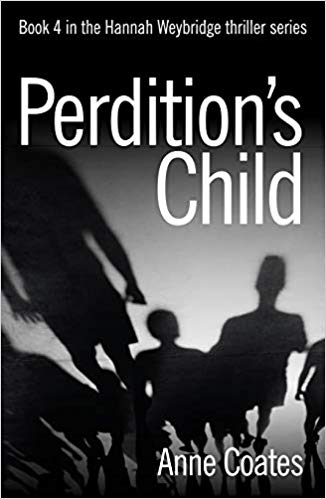
Perdition's Child - Anne Coates


Fourth book in Hannah Weybridge series by Anne Coates from Urbane Publications

Image

Since I started writing book review blogs a few years ago, I happened upon a writer called David Barker who wrote a sterling action thriller Blue Gold about the threat of water having wars fought over it.

Barker has since written three books featuring his protagonist, Sim Atkins, but the book read with such a zip full of vigour, great set pieces, easy to follow narratives and page turning pleasure.

Published by Urbane Publications, a small independent publisher that brings diverse voices to an eager audience. That word eager is key to their Twitter bio, a word that breeds enthusiasm and joy in writing and that is systemic in the work of Barker.

This reviewer is pleased to report that the book reviewing today, Perdition's Child by Anne Coates, repeats much of the same Urbane DNA - a different sort of book, a pacy thriller that was gorged in one day of reading over a long Bank Holiday weekend.

Anne Coates - Author of Hannah Weybridge series
Hannah Weybridge, is a freelance journalist, who seeks for the truth. This is the fourth book in the series, previously Hannah has combated crime against sex workers while trying to raise a young child without a father figure.

We find her on holiday with a new beau, the abrupt parting at the airport leads to her returning to work and walking into a string of strange murders connected by the link that they are all Australian citizens, back in the UK looking for the truth of their heritage and lineage.

Weybridge finds herself embroiled in the mystery of odd deaths, a bag lady taking over her deceased brother's residence thanks to the help of a lofty QC acquaintance, a gentleman who appears at inopportune times and the relationship between orphanages and religious bodies.

Coates writes with a whip-crack narrative, dialogue flies off the page providing characterisation, exposition and structure in multitude that is both pleasing and effective.  This effortless style of plotting and character helped this reader entering a four-book strong universe which is always the key to a good writer of crime fiction - being able to create a universe where someone can enter without feeling like a stranger.

The placing of the narrative in 1994 before the advent of global media taking ahold of all people helps - a world where people would be somewhere when they said, papers were trusted before becoming gossip-mongers - giving an unlikely nostalgic spin on matters.

If you like this work, go seek out the David Barker books and also Simon Michael's Charles Holborn series about a barrister in the 1960s in the shadow of the Kray twins hold over London.

Perdition's Child is out now from Urbane Publications.
My thanks to them for the review opportunity

Monday, 13 April 2020

Eerie Gaits - Holopaw


The new album from Eerie Gaits - Holopaw - is out now from Sound As Language


The side project of John Ross of Wild Pink, has been much anticipated, and is the second full length release following the debut of Bridge Music in June 2017.


Eerie Gaits is the instrumental sound board for Ross' compositional output, and fittingly during this weird period of social and cultural history, Holopaw is an album of contemplation and introspection during the period of collective lockdown.


From the opening track 'What's Eating You' Ross sets himself out as making an album with something for everyone, a wide array of influences from American music history abound from alt-country to electronica, country riffs to ambient sounds.

A hallmark album for this would be Bon Iver's debut 'For Emma, Forever Ago' which was released in July 2007; this is the album Justin Vernon would have made had he not felt the need to sing. Ross has created an album of nine-ambient compositions that are full of joy and community as opposed to Iver's paean to loneliness.

From the naturalism of 'Out In The Tall Grass' to the quietness of 'Oia' which shows a range of emotions in less than two minutes; from minimalism to full blown euphoric expressions.

The dexterity and virtuosity of this album is a wonder to behold, it seeks to be heard above the crowd and if given the right platform it will do - an album that is both wondrous and wonderful, it bears repeat listenings and in this day and age - currently of lockdown - you may have the time to do so.

Holopaw is out now on all formats via Sound As Language.
My thanks to them for the review opportunity.

Tuesday, 7 April 2020

Brian McGilloway Q&A


The Last Crossing

Last week I reviewed the new release from Brian McGilloway, the New York Times Bestselling author, with his new thriller The Last Crossing. A stand alone novel that looks at how actions can have ever lasting consequences.

After excitedly reading the book, the author granted me the pleasure of an interview which I can share with you now.


What was the genesis of The Last Crossing following your series of books, why a standalone novel now?


With each book, I simply write the story I want to tell. Usually, that fits in to one of the two series, but with this book it didn’t. I liked the idea of looking at 3 ordinary people who do something terrible for what they all believe to be justified reasons and who have to face that again 30 years later. I was interested in how each would have changed, how what they had done would have changed them, and the manner in which each had attempted or failed to reconcile themselves with what they had done. From the beginning, I knew this wasn’t going to be a police procedural, nor did I want it to be.


How easy was it to juggle the two timelines was it like writing two stories at same time or separately then edited?


No, I wrote one straight into the next using concatenation where the final phrase of one chapter opens the next. It was to create continuity between past and present and also to link the two more closely. It’s a technique used in a medieval poem called The Pearl which I’ve tried to use a few times before – most obviously in Little Girl Lost where I had two narratives connected in this way in the first draft. After hitting a block about three quarters of the way through, I realised it wasn’t working for that book and removed both it and the entire second narrative. I’ve been wanting to use it since and thankfully, in this book, the technique suited the structure and theme more obviously and finally worked for me. I found using it helped create impetus in the actual writing of the novel.


You are from Londonderry, the Troubles was more a way of life than a snapshot, was it easy to write about from memory having been born there?


I love Derry and am very proud to have grown up there. It suffered a lot through the years of violence to the extent that its personality and sense of identity have been changed by it in some ways. That reflects the way in which all of us who grew up through it were similarly changed by it in ways – some more obviously than others. The book, I hope, reflects the various gradations of impact the violence had on the various characters.


The story is about looking back at life's regrets do you have any?


I suppose we all have moments of wondering ‘what if?’ – the Road Not Taken moments. With the story between Tony and Karen, I’d say the influence of Tom Waits’ Martha is there – someone looking back on how their life’s course has gone in a completely different course from the one they’d expected and how we react when faced with that realisation as we meet someone we once loved. Larkin’s Dockery and Son deals with a similar moment of terrible clarity. My own regrets tend to focus on friendships lost more than choices not made – we all make our choices and live with them after all. I’m very lucky and blessed in so many ways, it would be churlish to regret.


What are your hopes for the book? 


It’s a book of which I’m quite protective. I just hope it finds any kind of readership and finds kindred souls to whom it speaks. It’s a challenge to get people reading Northern Irish fiction, so finding someone who’d not ordinarily have read fiction from here would be a bonus!


Did the speed and economy of the book come from editing or down to the jumping back and forth of timelines to induce this whip crack nature of looking back and forward ?


I suspect it’s a reflection of how I write. The book was written very quickly once I got started – and benefitted from the support of a number of friends and crime writing peers who read it and encouraged me along the way. I tend to write in short bursts – maybe an hour or so per day – and aim to keep things moving. I get bored with slow narratives myself, if I’m honest.


Do you miss teaching full time?


No – I still teach full time. I took a sabbatical for two years when my kids were younger to help look after them but have been back teaching for 5 years now. I still love it – though it does make writing a book a year almost impossible for me at least, thus the longer break between books. The characterisation of the younger character in the novel who drives the other three around was informed by great advice from a group of my former students who’ve all kept in contact with each other and me. It’s a privilege to introduce young minds to great literature for the first time and to spend your days talking about books you love.


What advice would you give to any would be authors?


Trust your instincts. Read widely, but don’t try to guess the market or write for the market – instead produce a work of which you are proud and can stand over and it’ll find a readership eventually. Writing is about connecting with a reader – the size of the readership will vary from book to book, but the essential connection stays the same and that’s the important bit.


How have you coped with self-isolation?


We’ve four kids so with six of us in the house altogether it’s been pretty busy. Plus I’m still teaching remotely, so the days pass quickly enough. I’ve great plans to get another book written and to read loads: I’m chipping away slowly at both…


My thanks to Dome Press for the review opportunity.

Irma Vep 'Embarrassed Landscape'


The new album from Irma Vep Embarrassed Landscape is out now from Gringo Records


Irma Vep is the alias of Edwin Stevens, a Glasgow based polymath musician, a man who has reached the potential now in his fourth album release.


Vep has garnered quite a reputation in recent years as a singular songwriter with immense confidence using a multitude of influences from across the musical spectrum to still sound like a unique voice.

From the outset, album opener 'King Kong' is as big a song you are likely hear as it is both bold, fresh and exciting.  It sets Stevens out as the sort of performer who has that intangible that you cannot measure - ambition. It is both brave and ballsy to open with a ten-minute track on any album, but it is neither grandiose nor showing off, it is a statement of intent to grab the listener from the beginning.

It continues in the next tracks which are more insular and reflective using violins and piano for atmosphere on 'Disaster' and 'Standards'.


More rockier numbers return with 'The Feeling is Gone' and 'Purring' which gives a balance to the open as a whole.

This album seems like the work Stevens has intended to make for several years, his growth as a person and artist has come to full fruition in the work of Embarrassed Landscape which is both a pleasure and privilege to witness.

Embarrassed Landscape is out now from Gringo Records.

My thanks to One Beat PR for the review opportunity.

Monday, 6 April 2020

Tottenham v Arsenal


This is the original post, read the full link at THE HISTORY BOYS website

In North London, there is a rivalry that stretches the length of Seven Sisters Road. At the South of it are Tottenham Hotspur, founded in 1882, two-time English League Champions, the first British team to win a European trophy and winners of the FA Cup eight times.


At the other end are Arsenal, recently of Highbury, but now at the Emirates Stadium in Islington. Founded in 1886 but not in North London, and there in lies the birth of the rivalry. Arsenal were founded by munitions workers in Woolwich, South East London as Dial Square before being renamed Royal Arsenal, then Woolwich Arsenal. The famous emblem and nickname of the club, the Gunners comes from the association with the munitions workers.


However, in 1914 after a flirtation with bankruptcy before the start of The Great War, they moved to a ground north of the river and dropped the Woolwich due to the transplant to become just Arsenal.

As our current socio-political climate with a mass global pandemic bringing professional sports to a standstill, the first World War suspended all sport until it reconvened in 1919. At the end of the 1914-15 season, Arsenal were languishing in 5th place of the Second division. The First Division was expanded to 22 teams with the two clubs atop the second division, Derby and Preston duly promoted.  Yet Tottenham were relegated, with Arsenal promoted in their place.

Thursday, 2 April 2020

Andy De Emmony Q&A


Director Andy de Emmony
My Q&A with director, Andy De Emmony, back in 2011. De Emmony is directing now THE NEST on BBC One starring Martin Compston and Sophie Rundle.
1. What firstly drew you to the film?

 I loved 'East is East', and found it quite daunting but on this occasion you get a more three dimensional character of George and it serves as a bookend to the first film. Ayub wanted to complete after the first film and it felt fresh even though it is the same family but on a different journey.

2. What do you remember of the original, 'East is East'?

I remember being drawn to the family aspect, and that generational gap within a family and where do you fit in.  But also the use of comedy as a release valve for the emotion presnt.

3. What was your working relationship with Ayub Khan Din?

We had a very good working relationship with Ayub, they came to me to collaborate after Damien O'Donnell did not chose to be involved.  And in spite of the autobiographical content he did not see it as a biopic, and instead lets just make the film work which gave us a lot of freedom.

4. What were the pros and cons of shooting in a foreign country?

 I found it quite daunting to work in India, but a pro was the manpower which allowed you flexibility (The house built by George in the film was built in 5 days by this manpower) and the long days allowed us to shoot longer in the days in comparison to England.  A pro would be the language barrier, as about 20% of the script is in Punjab and in the end it came down to reading looks of actors, and even some of the actors who spoke Punjab in the film had to have voice coaches for certain scenes. 

5.What happened to Jimi Mistry's role? And were you impressed by the debutant Aqib Khan

Jimi Mistry's role was written bigger, but the focus was on Sajid the youngest, his story and journey.  And Aqib was brilliant, he had a temperament that fitted the character and he was helped by the components and good actors we put around him.

6. Is there going to be a third film?

The producer, Leslee Udwin, has always seen the film as a possible trilogy and there is a proposal in place if people connect to this film like they did 'East is East'

7. How do you react to criticism of the film being 'quaint' or 'too much like a sitcom'.

I think when you make a film about a family it is hard to contain it and I hope the audience can reconnect and new audiences connect with these characters and laugh with them.  I felt if we had made a sweeping political statement about Pakistan, the family story and emotional bond would have been lost in the mix.

8. What have you been up to recently and what is next?

I have been shooting commericals in Australia, but we are waiting for funding [like most people in Britain] for a film written by William Boyd ('Chaplin', 'Any Human Heart') called 'The Galapagos Affair', based on John Treherne's novel, which we hope we start shooting soon.

Es - Less of Everything


First full length album from quartet Es from Upset The Rhythm in April 2020


Es are less a band and more a manifesto - lets be loud, lets be proud - a virtual coolness of pop friction, prickly in their composition but deliberate in their conviction.

The band are a four-piece, Maria Cecilia Tedemalm (vocals), Katy Cotterell (bass), Tamsin M. Leach (drums) and Flora Watters (keyboards) made noise in 2016 with their debut EP 'Object Relations' released on La Vida Es Un Mus label, they have become a prominent member of the underground DIY music scene since 2017


In the form of Tedemalm, the band have a vital front person who can be the focal point for the group. The band are as much about attitude and this is backed up by the dynamic of being relentless in this album - this is an emotional journey that carries you through the scale of nuance to complex; and while other DIY groups may sound cold there is a welcoming nature to this band. Es are ones to watch.

Less of Everything is out from Upset The Rhythm on April 3rd.

My thanks to One Beat PR for the review opportunity.