Showing posts with label blog review. Show all posts

Wednesday, 29 June 2022

Old Bones Lie


Old Bones Lie - the Sixth book in the DI Clare Mackay series -
out July 7th by Canelo Crime

Marion Todd has established herself in the last four years as a writer of great intellect, delicate plotting and wonderful characters based around the central figure of DI Clare Mackay who attempts to navigate the tricky neighbourhood of St. Andrews that has a murder rate to match Midsomer.

In six books to date, Todd has created the Mackay-verse with her band of characters handling criminal cases with swiftness and professionalism as crimes surround them. In this novel, proceedings begin innocently enough with a Saturday night takeaway which turns nasty as armed men come into the home of two prison officers with their wives, they kidnap all four people and the case begins.

What follows is a convoluted case involving a jail break, a jewellery heist gone wrong and the murder of a lady who is attempting blackmail on the owner of the jewellery shop. Keep up please it is a lot to take in.

As a reader of all of Todd's books to date, for whatever reason (perhaps mine) I found the first half of the book to be a bit complicated to follow but once the kidnapped women turn up this prompts the book to ratchet up a few gears quickening the pace to the benefit of the book and the enjoyment of this reader.

The plot is so well handled as always by Todd that you are left in no doubt that you are in the hands of a talented writer who takes great care over the narrative and loves her creations. The ending again shows Mackay at a crossroads of sorts both professionally and personally; yet you know she cannot alter her position too much.

Like her contemporary, MJ Lee from the same publishing house, this reader looks forward to the new St. Andrews suspense tome. As ever, the next one cannot come soon enough.

Old Bones Lie is out 7th July from Canelo Crime

Tuesday, 4 January 2022

A Very British Scandal - Review


The 3 part BBC series starring Claire Foy and Paul Bettany about the very public divorce of the Duke and Duchess of Argyll in 1963 was broadcast over the Christmas holidays and is currently available on BBC iPlayer.

A bit of history before we commence, the Duke and Duchess were married in 1951 culminating in a bitter divorce battle in 1963 after a tumultuous marriage, where the Duchess Argyll was shamed for her promiscuity and those reports in the court case were made public, most damningly the knowledge of a photograph where Margaret is giving oral sex to a headless body.

The series borrows heavily from The Crown, none more so than the casting of Claire Foy against type as a sexual creature in contrast to that of her noble majesty. Whereas, Bettany cranks up the villainy of the Duchy as a man-child, who merely wants to live a good life and be left alone to his own devious devices.

However, the script plays out both leads as nefarious individuals, heinous beings who are not very nice at all in all honesty - the Duke is a drunk who merely wants Margaret for her money, and the Duchess makes no apologies for enjoying the sexual company of any man.

The contrast between the two genders is startling and played to the hilt - whereas the Duke can have many an affair, it is the female requirement to tally and keep record that proves the Duchess' downfall as her diary with the pinpointing of social engagements marks her out as everything a woman and wife should not be.

The Duchess was one of the first women to be shamed by the media, while the Duke was made out as a shining beacon of aristocracy hurt by a woman beneath his status. 

The film is as much about status, class and the hush hush nature of sexual conduct within the upper crust, Margaret's friend, Maureen (Julia Davis) makes it clear that he way the upper class fornicate and run around with each other should not be made for the gossiping working-lower classes, and 'they will close ranks' if it so happens.

Funny that all this occurs in 1963, mere years later the swinging 1960s come into full force where sexual promiscuity was rife and mindsets altered.

Yet all in all this series was a missed opportunity, it attempts to make a statement about shaming women in this post #MeToo era yet the Duchess is not a likeable individual much like her husband, you do not show her pity and yet you do feel sorry that her situation was one she had to endure. Yet the film is so besotted with the aristocracy that it is afraid to formally admonish them.

A shame to report that this scandal was a meek affair

A Very British Scandal is on BBC iPlayer now

Book of Boba Fett: A Template Laid Bare


The Book of Boba Fett premiered on Disney+ on 28th December, providing a treat for Star Wars fans around the world during the festive period.

Using a now common narrative tool of dual narratives - we begin where the post-credits Mandalorian sequence ended with Boba Fett taking the seat once held by Jabba the Hutt in his eponymous palace flanked by Fennec Shand.

The episode starts with Boba in a tank recuperating from exertions and his nightmares return as he reflects, with us the viewer thrust into his dreams as he is within the Sarlaac Pit where he famously fell during the Return of the Jedi. We see Boba fight out of the creatures stomach, his hand bursting through the sand a la many a horror imagery, reaching for the sky.


Once out of the desert, he lays awaiting rescue. Unfortunately, the first people to encounter him are the scavenging Jawas who strip him of his mandalorian armour leaving him to waste away. Then he is taken in by a Tusken raider tribe where he has to endure slavery and torture from a youngling raider who is going through a rite of passage with Boba as the task at hand to overcome.

This story of Boba overcoming adversity to reach the level of nomadic stature when we encountered him in the second series of the Mandalorian where he retrieves his armour is next to the story of him becoming a crime lord in the same guise of Jabba. He meets many a new suitor, people wishing to win his favour and encounters a representative of the Mayor of Mos Espa, Tatooine's second city. Usually these people pay the crime lord, but the majordomo wishes for payment from Fett. 

Boba wishes to meet the Mayor but as they leave The Sanctuary they are ambushed and the best set piece of the first episode takes place with plenty of action, fighting and the opportunity for Shand (Ming Na) to parkour around buildings chasing the attackers.

That strand of the episode ends with Fett on his haunches being held up by now loyal duo of Gamorreans. We then return to five years prior where Boba is in servitude to the Tusken raiders - he and a Rodian have to dig for water by the teenage Tusken. They then encounter a Harryhausen-esque creature with four arms.


Boba shows industry and inventiveness to defeat the monster with only his hands and the chain that binds him. The Tusken allows Boba to walk unaccompanied back to the village where he is given a gourd - a sign of respect and that he is made in their eyes. He is now on a voyage to learn the ways of the desert which takes us up to his first (re)appearance in the Mandalorian when dressed in Tusken robes and garb.

While the episode is not as kinetic or thrilling as other chapters of the Mandalorian would eventually be, yet if memory serves the first ever episode of that series was along the same lines with the need to build up character and atmosphere. There are going to be lulls in this series due to the quiet intense character that Boba is along with the equally reserved Shand.

The bond between Fett and Shand will be key to this series - the mutual respect the two have for each other as outlaws in an albeit lawless galaxy - this wish to live and die by their own sword; they share looks that speak volumes to each other and can say things with a raise of an eyebrow merely to instruct the other. This is empowered by the totem that is Temeura Morrison as the title character, years of wear and tear on his face and body exuded a host of emotions to convey.

Directed by Robert Rodriguez and written by Jon Favreau, the template of the western has long been establised with the outsider being welcomed into a forbidden tribe to earn his spurs so to speak, to then rise up and take control of a town or county through his grit. In this instance, the western genre has been extrapolated and put onto the science fiction/fantasy world of Star Wars again to winning effect.

Whilst watching I may have been guilty of looking at my phone on occasion, but there was enough to maintain my attention and ultimately look forward to the next episode on Wednesday in the New Year. As always, this is appointment viewing and not to be missed.

Follow me on Twitter @NextToTheAisle

Wednesday, 25 March 2020

Margaret Glaspy - Devotion


Second album from American songstress Margaret Glaspy via ATO Records


The album is a collection of a dozen compositions that are about love coming in when you do not expect it, there is a soulful to this record in contrast to her debut 'Emotions and Math' which had a grittier sound and purpose. This is a record which has an energy of its own.

Songs that take on a life of their own, starting soft then becoming more universal as they ferment in the ether, much like the opening salvo 'Killing What Keeps Us Alive' a song that takes on this political comment but has a very personal energy to it due to the auto-tune nature with it being stripped back led by Glaspy's hypnotic vocal lead.

The distant cousin of Alanis Morisette's Jagged Little Pill but perhaps without the vitriol against men, this is an album that shows an artist spreading her creative wings and going for broke by putting her heart on the table and coming up trumps.


From the winning 'Without Him' and 'You've Got My Number' there is a yearning for love and the importance of love between two people, how a relationship can bring the best out of someone culminating in the brilliant 'Devotion' a song that is both about strength in each other and yourself.

Devotion is out from ATO Records on Friday 27th March.

My thanks as always to One Beat PR for the review opportunity.


Thursday, 8 December 2016

This Is Us

Image result for this is us

The new NBC show which is appearing on Channel 4 is one of those shows that comes along once in a while, and it is the sort of feelgood show that a nation in crisis needs.  Offering escapism from the trying nature of day to day life, the series offers a heartwarming glimpse of a life full of homespun notions of goodness and wellbeing.

Starting out with a silly Wikipedia reference, stating that any person shares their birthday with 18 million other people on the planet, we witness four people sharing their birthday. They are all 36, and it seems this is the mid-point crisis level for all three people.

Image result for this is us

Jack (Milo Ventimiglia) is with his pregnant wife Rebecca (Mandy Moore) who is expecting triplets on his birthday.  When her water breaks they rush to the hospital.  We then switch to Kate (Chrissy Metz), an obese woman who is keen to lose her weight this time in spite of self-help post it notes adorning her fridge, she has a twin brother Kevin (Justin Hartley), an actor at a fork in the road of his career, between being taken seriously as an actor in spite of appearing in lowest common denominator comedy where he frequently takes his top off to show his washboard abdominals.

The fourth person is black man Randall (Sterling K. Brown - who was excellent in The People vs OJ Simpson), a modern day successful professional who has found his biological father by way of a private investigator. Randall is reluctant to make contact with him, as he left him outside a fire station on the day he was born.

Image result for this is us

Having seen shows of this sunny disposition before (Thirtysomething, Ally McBeal) falling into the trap of having a good cast without the necessity of a solid script, This Is Us has the admirable quality of having a well written script that helps bring the best out of this well assembled ensemble and vice versa.

The script is clever as well such as when Randall describes his interaction with his father to his wife, as if it is some lame sitcom like 'The Man-ny' which Kevin is appearing in within the show; this willingness to refer to the intertextuality of lives and how similar people may watch the same shows in spite of racial differences is indicative of this unified world the show wants to picture.

The moments Randall confronts his estranged father and Kevin's breakdown on the set of his sitcom are neither histrionic striking the right balance between being heard and making sure they are said in the right way. Even the pediatrician who delivers Jack and Rebecca's triplets gives Jack a pep talk in the hall after the birth; it could be construed as too sweet for a serious moment, but the balance between the light and the delivery by Gerald McRaney is expertly handled.

While moments of saccharine may grate on bah humbugs in this seasonal time of year, those moments are necessary to the plot such as the birth of children or reunions of lost family members. The show does not ask too much of its audience, nevertheless, it leaves you smiling and beaming.

Image result for this is us

The reveal at the end of the pilot episode of the connection between the four thirty somethings is a real eureka moment of plotting by creator Dan Fogelman, ably assisted by co-directors John Requa and Glenn Ficarra. The twist allows for a more expansive exploration of the characters which will certainly get this viewer returning for more of this show's positivity.

This Is Us screens at 10pm on Channel Four weekly.

Monday, 21 November 2016

In praise of...Star Wars Minute

Star Wars Minute

In recent years, podcasting has become the go to for further analysis and insightful discussion about all manner of topics. For this reviewer it is a go to for all NFL, football, current media and arts. From Bill Simmons to The Guardian via Colin Cowherd, these podcasts give great information and keep abreast of all goings on. Whilst it may make the listener feel like they are being spoken to, the garnering of information from various source makes you a more nuanced and knowledgable consumer.

And when on social media you become aware of other podcasts and products of discussion which led me to becoming aware of the Star Wars minute podcast. A podcast by Alex Robinson and Peter the Retailer, two self confessed Star Wars nerds who took on the impossible task of analysing, scrutinizing and celebrating every Star Wars film one minute at a time.

Image result for star wars minute images

That means every minute, including credits of each of the now seven films.  They started with Episode IV - A New Hope and have gone in chronological order of production. When I first encountered them they were thirty minutes into The Phantom Menace, so I had some catching up to do. Nearly a year into listening to them I have listened to all of Phantom Menace and Jedi, I am an hour into Empire with Attack of the Clones just started.

My praise for the podcast is that it is consistently witty and funny; its constant poo-pooing of the idea of the force as being categorised by midichlorians, Obi-Wan Kenobi being a complete liar throughout the films, the long con of Senator Palpatine and Yoda having a Grover moment, after all he is a Muppet.  Even to the point that Jar-Jar Binks is not the worst thing about The Phantom Menace

It utilises the guests - look forward to the episodes of Chris Radtke - to great effect and the ambition of the idea has clearly come to fruition as they are now the godfathers of minute-by-minute podcasting.

There influence can now be seen by the number of films being dissected in this manner from Back to the Future to Alien cycle to Ghostbusters. They have created a market that cinephiles, geeks and nerds all together can celebrate their favourite films. 

Image result for star wars minute images

What comes across most in each pod is the reach of cultural knowledge that the two presenters have, using all that hidden away vaults of past television programming, obscure films and catchphrases to good use when talking about Yoda's bulging eyes when Luke Skywalker attempts to lift the X-Wing out of the swampy waters, they reference Don Knotts from Three's Company and Marty Feldman of the 1970s. It shows how influential televisual culture was on children born in the late 1960s and early 1970s, and how important those programmes were as avatars of parenting and moulding of children.

The podcast is growing more and more, they have just begun Attack of the Clones as I mentioned and while I look forward to them dissecting the worst episode of the Star Wars cycle there promises more to come with Revenge of the Sith this time next year and eventually The Force Awakens in 2018.

You can support Star Wars Minute via Patreon, where you can access bonus episodes and help keep the website going. And follow them on Twitter @StarWarsMinute

There is a great community of Star Wars fans who went quiet before the second trilogy appeared in 1999 and since has got stronger. With Disney buying out George Lucas and now owning the franchise, the forthcoming origin films of Han Solo, Lando and Boba Fett promise that the community will only get bigger and this sharing of affection and love of the film will keep getting stronger.

Monday, 22 February 2016

The Night Manager

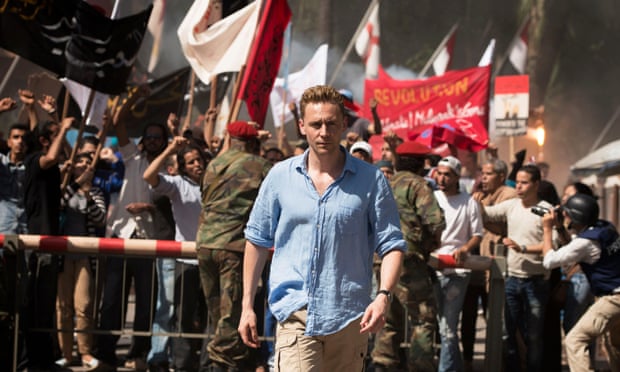
Spy master… Tom Hiddleston in The Night Manager

The BBC have brought to the small screen in their 'Pure Drama' field an updated and altered John le Carre adaptation to fill up our Sunday evenings for the next six weeks.

The novel, The Night Manager, was released in 1993 and set in Cairo; the adaptation by David Farr (Spooks) has been updated to January 2011 in the same city during the now famous Arab Spring.  We encounter a white British man, Jonathan Pine (Tom Hiddleston - all charm and confidence) walking through the battered backstreets of the Egyptian capital as revolution takes place.

At work, he is suave and debonair, breezily dealing with rocket attacks on his hotel as international guests attempt to flee the city.  That night he meets a mistress of a renowned family man, Freddie Hamid; she is Sophie, a middle Eastern jewel. They flirt and they inevitably sleep together, she imparts upon Pine some information relating to the Hamid family buying weapons and munitions from renowned wicked man, Richard Roper (Hugh Laurie). Sophie calls Roper, 'the worst man in the world'.

Image result for the night manager images

Pine fears for Sophie's wellbeing after giving this information to a delegate at the British embassy, Simon (Russell Tovey) who hands it on to a bitter worker of the International Enforcement Agency in Victoria, London; Angela Burr (Olivia Colman), who is seemingly at loggerheads with MI6 in how to capture Roper and his machavellian ways of trade and commerce.

Pine's fears are realised when Sophie is killed in her hotel room, this leads to a fast forward to four years later where Pine has relocated to Zermatt, Switzerland at the Meiseters Hotel in the Alps over the Christmas period. The hotel is expecting a late arrival of guests, namely Roper and his entourage including a fay Tom Hollander as Roper's dogsbody.

Pine sees this as a chance to help the UK government entrap Roper and so contacts Burr who comes to Zermatt personally to meet up, and so begins their mission to get Roper.

If this all sounds so BBC, so British and so Bond; you would not be wrong with that assumption. The film (and it is a film, under the guise of a television series) is directed by Suzanne Bier and she does well to shoot a sense of place from the sweaty humidity of Cairo, to the juxtaposition of a freezing London office with no heating ending with the picture postcard beauty of the Alpine landscape.

This can be construed as one long James Bond audition for Hiddleston, who does well with his calm moments and allows Pine moments of sensitivity and naturalness, such as throwing up after checking Roper into his room.  Yet being an ex-soldier who served in Iraq, he knows how war works and how it affects you; Pine is self-effacing and ready for a challenge, the way he gets the sim cards from Roper's phones is both ingenious and smart.

This is event television the like of which the BBC has strained for a number of years, but it shows that to gain that event status of a high water mark series you need the perfect storm of three actors (Hiddleston, Colman, Laurie) at the apex of their careers, a stellar supporting unit of familiar BBC faces (Hollander and Tovey), a renowned internationally acclaimed director (Bier). And the story, it is always about the story. The combination of le Carre, the BBC and Hiddleston makes this a drama not to miss.

Tuesday, 23 October 2012

LFF 2012: Material

Craig Freimond's second feature length production Material stars Riaad Moosa and Vincent Ebrahim in the cross-generational story of a young man, Cassim (Moosa) who does not want to follow in the footsteps of his father, Ebrahim (Ebrahim) in their fabric shop in Fordsburg, Johannesburg and instead take on the career option of stand up comedy.

Freimond comes from a theatrical background and this in unison with Moosa's autobiographical tale of leaving his medical career for the same stand-up pathway, provides the foundation for the screenplay of this South African production.

The tone of the film is handled expertly between the dramatic conflict of a son refusing to follow in the tradition of his father and instead strike off for independence; and the laugh-out loud content of Cassim's set which takes the mickey out of his culture and religion ('When Europe had a swine flu scare, they all avoided pigs. We've been avoiding pigs for years!') and yet coming up with a catchphrase for all Indian people who are arriving late - 'Where are you?' 'I'm fifteen minutes away bra!'

At the start, Cassim seems happy but slowly and surely we see more and more of his nocturnal life, as if he is living a double life away from the prison of the Islamic household.  We also learn more of Ebrahim's history and why he comes across as so tyrannical, stemming from a long argument with his more affluent and successful brother who owns a fabric shop in the more prosperous Oriental Plaza a stone's throw from Ebrahim's shopping precinct.

Cassim also has a cousin Yusuf (Joey Rasdien) a typical comic supporting character - overweight, a bit thick but who has a quick put down similar to McLovin in Superbad; if you were to paint his silhouette you would remember him.  The dialogue between Rasdien and Moosa is at time so funny, it puts Hollywood bromances to shame with its intellect and quick wit.

The film even allows itself a romantic sub-plot when Cassim gets the thunderbolt (like Al Pacino in The Godfather) for Zulfa (Carishma Basday) a beautiful woman who has blossomed from the ugly duckling into quite the swan for Cassim to dote over.

The film's script which was partly improvised by the cast is dealt with admirably and goes against the grain on  occasion, such as when Ebrahim witnesses Cassim's first set at The Attic comedy club.  In Hollywood, this scene would have been handled differently, for example Cassim would have seen his father and frozen on stage (this does happen though later), instead Ebrahim has to feel the shame of (in his eyes) the blasphemous content whilst the arc of Cassim's development and growth as a comedian is seen for all its glory.  He gets laughs from all creeds and colours, showing the universal appeal of his material.

Keen eyed observers will feel the film is reminiscent of the notable British film East is East from 1999, however, whereas that film had a much darker subtext of domestic abuse this film is more focused on the generational battle and the rebuilding of burnt down bridges, as enforced by the matriarchal grandmother.

Like most dramedies the film's final act is prone to the sentimental finale, yet the joy of the characters and the conviction of the actor's performances allow us to become misty eyed for a good reason.  The ending does not feel forced, nor inevitable due to the universal pull of the story - the scene where Ebrahim's wife and Cassim's mother Fatima (Denise Newman) walks out of the fabric shop shortly after Cassim has, is quite moving in its less is more execution.  A plea for acceptance, a denial and then a walk out is evokes an amazing amount of emotion from such a small scene.

Material has enjoyed an amazing box-office run in its homeland of South Africa, and with the quality of the comedy being so good, the film should do well in foreign territories starting here in the UK where a large audience awaits it.

It received its UK premiere at the recent London Film Festival, and will be screening at Film Africa 2012 (@FilmAfrica #FilmAfrica2012) on Friday 2nd November at the Hackney Picturehouse followed by a Q&A with the star Vincent Ebrahim.

Thursday, 7 June 2012

ill Manors

Plan B the maverick singer and songwriter is born and bred in East London.  He is a proud Londoner, loves his city and the people in it.  Yet Ben Drew (his real name) can be thought of now as a renaissance man; a man of many trades.  He sings, acts (is about to star opposite Ray Winstone in the forthcoming Sweeney remake), produces his own music and now is a writer and director also.

Drew has written and directed ill Manors, a film set in and around his East End neighbourhood with a whole host of shady characters.  The film is just over 90 minutes long, but it uses a convincing labyrinthe plot where all the characters intersect and collide together.  At times the film can be very funny with its off the cuff remarks about authority and politics, or from the sharp angle of character themselves.  But Drew is not afraid to paint his characters in dark tones, at times the film is quite horrific in what some characters do - the prime example being when our hero Aaron (Riz Ahmed - Four Lions) and Ed (Ed Skrein) use a prostitute who they believe to have nicked Ed's mobile and use her to pay off his debt by sleeping with kebab shop owners.

Throughout this scene when the grubbiness of these late night kebab shops seeps off the screen, Aaron refuses to want to be any part of it.  Yet he has to remain by Ed's side like some lackey.  Aaron is the moral core of the film, a man with ambition to be true and get a career away from drugs and gangs of his youth.  We first meet Aaron as he meets Ed getting out from a night in prison, Ed sits there listening to people arguing (Drew's first funny scene is showing a verbal argument between a white man and a black man without showing them - instead focusing on their footwear as representative of who they are.  White trainers for the caucasian, and huge colourful trainers for the black youth), and from the outset Drew is attempting to do something different with the story.

Often he will focus on a character who you think will be the main character, but suddenly they are dispatched with by means of narrative or intervention by the soon to be character.  Yet Aaron remains for us to be the moral authority, by constantly doing the right thing.  In contrast to the sheer lack of authority figures visible in the piece, you need one character (like Spike Lee's character Mook in his own Do The Right Thing) to stand up for what is right.

Drew also does the soundtrack for the film, giving himself the chance to narrate as his alter ego, Plan B, gives his political slant on the action happening.  Plan B is very critical of the government and blaming them for the children of the nation being lost.  The film was being made during last summer and then the riots of Tottenham burst into the national consciousness in August, Plan B released his protest song 'ill Manors' and this vein of anger and resentment has grown into this message film.

The idea of a singer doing a film can sometimes be awful, but Drew has been keen to use popular film influences as a signifier, and they are not bad ones - Taxi Driver, Pulp Fiction - are both films that showed you a harsher side of the perceived reality of city life. Whereas Scorsese used hyper-violence on occasion, and Tarantino had the benefit of plot devices.  Aaron flexes his muscles in front of a mirror with a gun a la De Niro.

The best thing to say about the film is that people will probably have low expectations going in to it, meaning that people will be pleasantly surprised by the funny, creative and refreshing film that is on the screen.  Helped by a fine performance by Riz Ahmed as Aaron, that should increase his profile definitely - hence why the poster has Aaron front and centre; the cinematography feels fresh, the music is good as expected.  Expectations may be low, but it is good to see Ben Drew/Plan B stick to his guns and come out with such a gratifying and pleasing film.

ill Manors is released by Revolver Entertainment and is out now.

Sunday, 27 May 2012

Journey 2: The Mysterious Island

Journey 2 feels like an adventure re-tread of many books, serials and borrows freely from many monster movie adventures as we see our stars scooting around on the back of bees encountering larger than life animals and other creatures of nature.

The story revolves around Sean (Hutcherson), the angst ridden teenager who has to co-exist with his mum's new husband Hank (Johnson) on a journey to find Sean's absent grandfather, Alexander (Caine) who has mysteriously disappeared believed to be on an island.

As they crash land near the last known point of contact with Alexander, they enter the island and encounter big creatures that dwarf them by comparison - now they could have conceivably eked out tension by leaving the reveal of the grandfather for sometime.  Yet Alexander appears almost immediately, and joins them on this quest for more adventure - where the true quest should be to find a basis for a family.

The script is weak, yet in Caine and Johnson, they were lucky enough to find two actors of genuine charisma and humour who are able to exert a bit of character into any scene albeit flat ones; even Luis Guzman can entertain and hold your attention with any role.

The special effects are not that great, and would not look out of place in a 3D adventure ride at a theme park - yet it will have enough thrills to entertain children.

A mistake of the film's marketing was to have us believe that it was meant to be for children of all ages, where the term pre-adolescence would be a fairer assessment.

The sequel to the box-office hit, Journey to the Centre of the Earth, starring Josh Hutcherson, Dwayne Johnson (The Rock) and Michael Caine is full of fun and released on DVD, Blu-Ray and Triple Play out on Monday 28th May

Thursday, 24 May 2012

Bertrand Bonello Q&A


French director Bertrand Bonello returns with his fifth film, House of Tolerance (L’Apollonide), a languid yet compelling story of a Parisian brothel at the beginning of the 20th Century. Featuring an ensemble cast of female talent, including Hafsia Herzi and Jasmine Trinca, the story rigorously shows daily life in the house – the camaraderie, the anguish and the horrors of serving men in this age-old profession. Below, Bonello reports how the film came to him in a series of dreams, how scared he was working with a dozen women and gives an insight into his next film, a biopic of fashion designer Yves Saint Laurent.  

Q: What interested you about this era? 
A: I started to work on this because I really wanted to do a film with a bunch of young girls. And I didn’t want to do a film that would tell love stories today. So I tried to find a strong image of young girls, and then I came to this image of the girls in brothels in the beginning of the twentieth century. I had read some books and I was very impressed by their strength. So after that I started to do some research, and the second thing that really excited me was not prostitution but the location. The idea of setting up a film in a brothel…for me was a fantastic location for a movie, a fantastic place for cinema. 

Q: It feels very claustrophobic and oppressive inside. Was that the kind of atmosphere you were looking for? 
 A: Yes. For me the fact there is no possibility to go outside, and no windows opened, you’re cut from reality. The outside does not exist. So for me, it was the possibility to make a film that would become more and more mental to the brain! To me, the brothel is like a movie theatre. When you come into a movie theatre, there are no windows, you don’t hear the sound outside and you’re ready for fantasy. 

Q: How did you find working with all these women on set? 
 A: I was a little scared before. It’s twelve girls so you never know! But the casting was nine months, a very long casting, and I was very obsessed with finding good actress I like, but most of all finding the group. So I think I did, and they really got on together very, very well. I felt more like a football manager – though that’s eleven and not twelve! 

Q: Are many of the actresses well known in France?  
A: Only one – Hafsia Herzi, who won the César for the Kechiche film Couscous. And there is another one [Jasmine Trinca] who is Italian and very famous in Italy.  

Q: But there wasn’t any pressure to cast a well-known face in the film? 
A: Not too much, not too much. I accepted to meet some famous actresses, but the distributors agreed that they were not so good for the part. If you have someone too famous, it’s difficult to make a group, because you see just her.  

Q: You use split-screen and contemporary music at times. What was behind your stylistic choices? 
A: There were many things. First of all, I decided not to feel free about everything I wanted to put in the film. One fear when you make a film in one location is that it’s going to be theatrical. So I wanted to give myself the possibility to use all the tools of cinema. Split screen is one of them, and so are the flash-forwards. And for me, the split-screen was…I saw the film very much as a film of prison, and the split screen was like security cameras. This idea that you’re never alone; even in the bathroom there is someone watching you. And the music…it’s soul music from the Sixties. I don’t know why but for me the soul music represents very well the idea I had of this bunch of women in a brothel. Maybe because there is a relationship with slavery, maybe because it’s soul, but really the sound of the girls for me was this music. I don’t have a theory about why, it was just a sensation.  

Q: You also show a contemporary shot of Paris at the end. Why? 
A: Well, it’s a fake documentary – but it’s meant to show foreign students. It’s true that now, most prostitutes are from abroad. First of all, there is one character who is the same, and it shows that it was her destiny to be a prostitute for life. Even a hundred years after, she’s still a prostitute. It’s something about destiny. I like the idea that we showed it this way, because only cinema can do that. The other thing is, for me, I saw the film as a matrix. And how do you get out of a matrix at the end, and back to reality?  


Q: The most powerful image is the facial scar that Madeleine endures. Is it true that this was based on the Victor Hugo novel, L’Homme Qui Rit?  
A: In fact, the film that was made of the novel. It’s a film that was made in the twenties – The Man Who Laughs. It’s a silent film by Paul Leni. I saw that when I was a kid, and the images really stayed very strongly inside of me. When I started to write, three nights in a row I dreamed of this film. I don’t know why. So when I woke up on the fourth morning, I said ‘OK, I’m going to try to put it inside the film to see how it goes.’ And then as soon as I started to write the first sequence I had a skeleton for my film with this character.  

Q: Do you think because you were reading about the subject a lot, that’s why you were dreaming about it? 
A: Ha! Yeah, maybe. And this film of Paul Leni, it’s one my very few strong images from childhood, in terms of film. I saw it again when I was writing, to see if there were some details I could pick up. It’s a heartbreaking film.  

Q: Have you had any problems with censorship with the film?  
A: Not problems. A little bit in Asia. I don’t remember exactly which countries – I think Taiwan and Singapore. But the film also sold well abroad. I didn’t have many problems. I’ve had my problems with my other films, Tiresa and The Pornographer.  

Q: Obviously, you’re showing it exactly as it was, so the nudity is not gratuitous… 
A: Exactly. And at the same time, if you think about the film, there are no real sex scenes. So there’s no real point of using censorship. 

Q: And the men often seem to be clothed, with the women naked around them… 
A: Yes, that’s what I read. Even women, you see the breasts but they are not totally naked. They have so many clothes on them that if you get totally undressed, and dressed again, it takes a long time.  

Q: The women talk very frankly about sex. Why? 
A: I wanted to show that sex is an everyday job. There is nothing sacred about that. It’s just normal. Like if a baker was talking about his bread!  

Q: In England, at least, sex was never talked about then… 
A: In France also. At that time, even married couples, they didn’t see each other naked. They dressed under the sheets. Even in France, people were very shy. I think that’s why brothels existed.  

Q: Did doing the film change your views on prostitution? 
A: Well, it’s difficult to have one truth. It’s a very complicated subject. My opinion is that prostitution always existed and will always exist. So I think it’s worth trying to give these women the best working conditions, in terms of social help and health. It’s too difficult to close your eyes and say ‘I want to forbid prostitution.’ Closing your eyes is not a good solution!  

Q: Are you working on a new film now? 
A: Yes, I’m working on a biopic about the life of Yves Saint Laurent. It’s François Pinault who has got the rights to his life. We are half way through writing the script. And we are starting to do the casting, but I don’t think it will be someone famous.  

Q: What fascinates you about Laurent? 
A: I think he’s unique. I think he’s maybe the only one I can say who is not only a fashion designer, he’s a real artist. And he died of that.

House of Tolerance is released on DVD on Monday 28th May courtesy of Universal Pictures.