Showing posts with label sports book. Show all posts

Monday, 8 May 2017

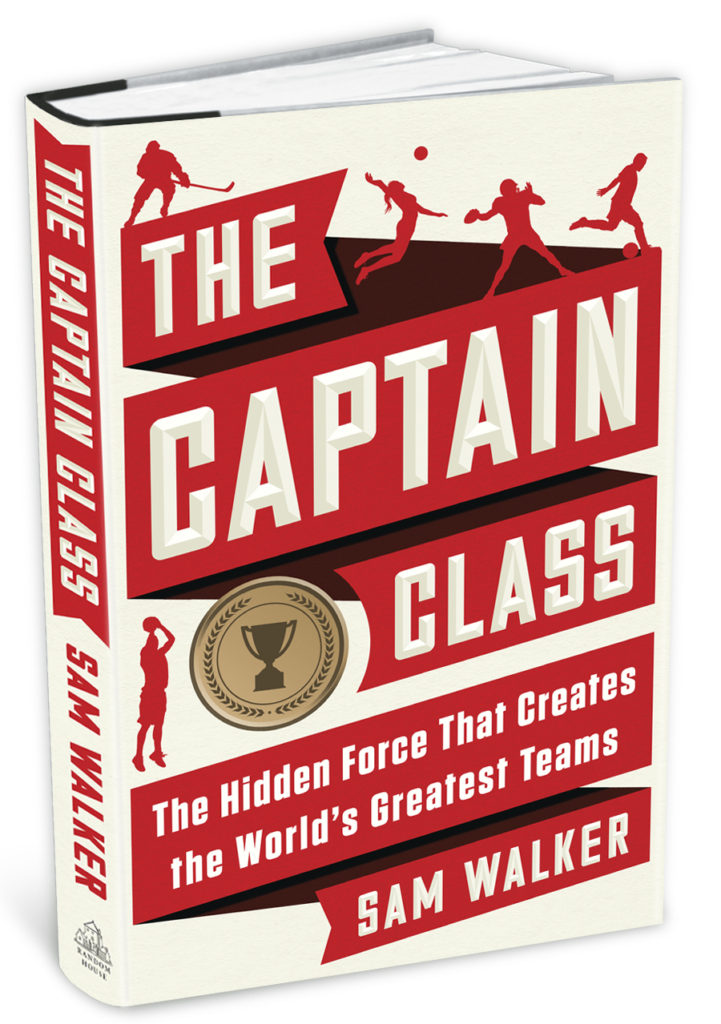
The Captain Class


Written by Wall Street Journal writer, Sam Walker, The Captain Class is a look at how the captain of a given great side can have the influence on a team's performance perhaps greater than the more heralded coach or manager.

Using a mixture of in-depth research, statistical analysis and psychological studies, Walker has looked at team sport across the spectrum and attempted to nail a theory that perhaps the Captain is the focal point of these Tier One (elite) sides that separates them from the Tier Two sides that fail to break through; this difference leads to dynasties and dominance instead of one-season wonders.

Image result for carlos puyol

In the first part of the book, Walker breaks down what makes a great team; was this team in the sport far and away the best side, did they beat equally great sides, was this dominance sustained over a period of time sometimes with managerial/coaching changes occurring. This analysis includes win percentage and record against equally high percentage win sides in playoffs and championship matches.

Walker is good in bringing light to some unheralded sports, the most distant team he selects is the Collingwood Magpies who ruled Australian Rules Football between 1927-1930.  Other teams selected are from Cuba's women's volleyball team (1991-2000), the women Hockeyroos of Australia (1993-2000) and the French men's handball team (2008-15) whose captain Jerome Fernandez led the team to a European Championship win knowing his father was on his deathbed.

Image result for jerome hernandez handball

In an early chapter, Walker makes the point that the teams he notes are not led by a supreme talent as their captain but within that side may be contain an elite or illustrious talent yet having an elite talent does not mark it out as a Tier One team, hence why Michael Jordan's Chicago Bulls side is absent.

However, within these great teams selected by Walker are the Brazil soccer side which had Pele, the Barcelona football side of this millennium which contains Lionel Messi and Dan Carter in the New Zealand All Blacks of 2011-15.

Yet by the end Walker brilliantly deconstructs the legend of Jordan as a leader and why he does not make the cut. Walker's ideal leader is one who shies away from the limelight off the court, would rather fold laundry and get 12 hours sleep a night; they lead by example, bending not breaking the rules to gain a distinct advantage in flashpoints, using both verbal and non-verbal communication to instil motivation into their teammates. 

Image result for tim duncan

This is indicative in the chapter concerning Tim Duncan of the San Antonio Spurs, an NBA side that has made the playoffs for the 19 nineteen seasons Duncan was a professional in the league before his retirement last summer.  Duncan is a man who does not waste his movement on the court, hence his high efficiency numbers, he is a presence without being overbearing and he speaks to his teammates in platitudes instead of shouting. At times he may have been boring, but his winning record would suggest that if it wins 5 NBA titles do not knock it.

One criticism I would aim at this list is the absence of one cricketing side from across the vast history of the sport when there have been periods of dominance in the Test match arena by either the West Indies of the 1970s/80s to the Australian sides led by either Don Bradman in the 1940s or the 1990s side captained by either Mark Taylor or Steve Waugh.

Image result for don bradman

My argument would be that Walker has concentrated on team sports and has not given attention to the sport not requires a strong captain as a necessity for success; an individual that can inspire and yet not break out with record scores or statistics.  Much has been made in the past about the leadership of Mike Brearley for England Cricket side in the late 1970s/early 1980s, a captain who was the best captain but definitely not the best player who could motivate some failing troops. 

However, Walker decides to ignore the achievements of Don Bradman, still one of the greatest cricketers of all time who retired with the highest average in Test cricket whilst overseeing a dominant period in their history. On the other side of the coin, you have Clive Lloyd, captain of West Indies, who was not the best player but inspired with great innings and was tactically astute to make big differences on the field of play. 

Cricket is a game that requires in-game tinkering and leaves a coach very much impotent to the on-field action; the captain dictates field positions, bowler rotations and tactical tinkering to combat an ever-changing batting line-up and the captain is always the most prized wicket of any bowling side. Whilst Walker makes an explanation in his discourse nevertheless it is something this reader should not have been ignored.

Sam Walker Sports Writer
Author Sam Walker

Nevertheless, this is a brilliant book that is both page-turning, entertaining with the stories of these legendary characters who may shrink from the limelight off the court but shine brightly once they are on it with their leadership and influence that lives on in their sport and their clubs/national team histories. 

With his amazing research Walker has himself led by example as to combine the best of both worlds, the acumen of the academic world married with the all encompassing passion of sports and competition convincingly shining a light on the unsung heroes of team sports in recent history.

The Captain Class is released in the UK by Ebury Press on 18th May in Hardback

Tuesday, 21 June 2016

Erik Kirschbaum Interview


Following on from my review of Soccer Without Borders which I reviewed via NetGalley, I had the pleasure of interviewing the author, Erik Kirschbaum, via a request with his publisher Picador in America:

- What was it about Jurgen Klinsmann that made you think you could write a book about him?
We had dozens of interviews and conversations over the years after I started covering him in 2004 in Germany, mostly for stories for Reuters, and I found his determination and courage to shake things up and take on the status quo fascinating. As a journalist and amateur student of history, I've always been interested in people who aren't afraid to go against the grain and are ready to take on conventional wisdom even at the risk of getting bashed on the head. I started looking around for books in English on Klinsmann and couldn't find any, so I asked if he might be interested in working on a book together with me in about 2007. He said he wasn't interested about 10 times before he finally agreed in 2014, right after the World Cup in Brazil. My argument was: as an American who spent half his life in Germany, I could hopefully explain to an American audience what Klinsmann, who has spent half his life in the United States, a little bit about where he's coming from and what he's trying to do. Compared to most soccer coaches and soccer players, Klinsmann is incredibly open, honest and straight-forward. It's a refreshing change of pace for journalists and soccer fans, but it does sometimes cause tensions and problems with some journalists, players, fans and the special interests who seem to be happy with the status quo and don't like all his moving and shaking. 


- It isn't necessarily a biography but I know more about him now, do you think he is misunderstood?
Yes, I think Klinsmann and what he is trying to do with soccer in the United States is not really understood or not really appreciated in the United States. Contrary to what some in the U.S. might think, he is by no means a mercenary coming in from Europe and trying to change everything in the United States. He has lived in California for nearly 20 years and watched his kids growing up with soccer in the United States. He is much more American than German these days and over the years our conversations have switched to 50-50 German-English to almost all English. And because he is so open, his comments and ideas are sometimes taken out of context and used against him. For example, he gave an interview last September to an experienced soccer writer at a major U.S. newspaper expressing the hope that those who follow and write about soccer in the United States could become more "educated" about the nuances of the game -- for instance that the performance of a team in the World Cup is the absolute gold standard globally and what soccer people around the world will talk about for the next four years...and that friendlies or Gold Cups or Confed Cups, while interesting, aren't really that important in the bigger scheme of things. But instead of taking that as a constructive suggestion, it was used against him and Klinsmann was blasted for being condescending. There are countless other examples of Klinsmann being criticised in the U.S. for things that soccer followers in other countries, like Germany, ask: "So? What's the problem with what he just said? That's the way it is, isn't it?" You can accuse Klinsmann many things -- like maybe being too demanding -- but I think he is anything but condescending. He simply wants to help U.S. soccer take big steps forward and win the World Cup. 

Erik Kirschbaum
Erik Kirschbaum - Author of Soccer Without Borders

- Do you think his tenure as American coach has been a success, is there more to come in next World Cup?
I think Klinsmann's five years in charge have been a tremendous success and I think anyone who honestly looks at the way the team is now playing in the Copa America, or played against really big teams like the Netherlands and Germany last year, would have to agree the style of play, the pace, the aggressiveness, the skill, the fitness and the tactics have improved. They would have to improve because pretty much every other national team in the world has improved in these last five years. The game is faster now than ever before and the game has simply moved on. If the U.S. hadn't improved, the team would probably have fallen from a top 30 FIFA ranking to spot in the top 60. Five years ago the U.S.M.N.T. played friendlies mostly against other teams in the CONCACAF region. Now, Klinsmann has been scheduling friendlies against the world powers in Europe -- and doing surprisingly well. His plan and goal is to get U.S. players accustomed to playing against the game's big names so that when a World Cup semi-final or final rolls around in 2, 6 or 10 years, they won't be intimidated or overly impressed by the big names on opposing team. That's another reason why he wants more top U.S. players in the world's best leagues in Europe, competing on teams in the Champions League, in order to improve their own game but to see that the Messis, the Ronaldos and Rooneys of the world are are not super-human but just ordinary people as well who can be beaten. 

- Does Klinsmann require more from the MLS? Should he convince players to go and play in Europe?
Despite what some of his critics say, Klinsmann is a big fan and supporter of MLS and believes that for some players it's the right environment. I don't think he has ever twisted anyone's arm to play in Europe. But he believes, as do most soccer followers and experts around the world, that the best leagues and best teams are simply in Western Europe. And if a player wants to raise his game, top clubs in Europe are the place they ought to strive for. Most American soccer players understand that too. That's what the best players in South America, Mexico, Asia and the Middle East are doing -- trying to get to a top club in Europe and play in the Champions League. Why is the United States the only country in the world where that idea is so disputed? All the best basketball and football players in the world want to play in the NBA or NFL. I think Klinsmann will obviously be glad to see, one day, when there will be 20 or 30 or 40 ambitious American soccer players making an impact on teams playing in the Champions League -- whether those clubs are in England, Spain, Germany, Italy, France or wherever. But I also think that there will always be some MLS players on the U.S. team as well and I think he hopes the level of play in MLS will keep rising as it has to narrow the gap. 

Image result for jurgen klinsmann
Jurgen Klinsmann has exceeded expectations

- What has changed since the World Cup in Brazil? How has he handled the changing of the guard and retirement of Landon Donovan?
Parts of the U.S. soccer public and media seem more critical of Klinsmann now than before the World Cup -- which baffles me and many others who follow soccer in Europe. He helped get the U.S.M.N.T through the "Group of Death", one of the toughest World Cup groups ever, with a win over Ghana and a tie against Portugal. That was a huge step forward and tremendous accomplishment by any measure. Soccer followers around the world took note and said "Wow, the U.S. isn't a door mat anymore". That was a giant step forward. Before the World Cup, major soccer writers in the U.S. were saying Klinsmann would be a "visionary" if he got the team through the Group of Death without Landon Donovan. He did it and yet the criticism only seemed to get louder. Why is that? In any other major soccer country, a national team coach deciding not to nominate a 32-year-old forward who wasn't scoring goals in the league anymore and had taken a sabbatical from the game the year before might be criticised or challenged about that for a few weeks. And if the team then performed better than expected at the World Cup, it would be the end of the story. But in the U.S. there seems to be a lot of sentimentality for Donovan, perhaps because in other sports like football, basketball or baseball a team can carry an ageing veteran into their late 30s. But soccer is different and no major soccer power would ever put a player past his prime on the team or the field for sentimental reasons. It just doesn't happen. Also, Klinsmann had experienced as a player first-hand how important team chemistry at a big tournament is. At the 1994 World Cup Germany was the defending champion and had an even better team than in 1990 but got knocked out in the 1994 quarter-finals because there had been so many distractions on the team. His point of view is that team chemistry for a big tournament is vitally important, everyone needs to row in the same direction, and back-up players need to understand their role as back-up players. I think Klinsmann is trying hard to find and nurture younger players to step into the shoes of the ageing veterans but the talent pool in the United States is not as deep yet as it is elsewhere so it's a great challenge to find the right mixture of old and young. I think the Copa America is showing that he's got a pretty good touch with some hungry young players like Wood, Brooks, Zardes, Pulisic, Nagbe pushing some of the vets such as Dempsey, Bradley and Jones to raise their game. The chemistry seems to be excellent. 


- Can America compete without a marquee player like a Messi, Ronaldo or Bale?
Yes, definitely. Germany rarely has a marquee player yet has won four World Cups and there Euros. To their own great frustration, neither Messi, Ronaldo nor Bale have yet to win a World Cup or Euro. Obviously, it's a team game and the performance of the entire team is what wins big tournaments. But who knows? Maybe in five or 10 years, we can have this conversation again, and see that America has produced such a standout player. 

Image result for pulisic
Christian Pulisic - the future of USMNT

- What is your writing routine?
I usually try to get cracking as early as possible in the morning. For some reason when I wake up my head is full of ideas about what I'm working on or should be working on, as if the ideas have been swimming around in my brain all night and then settle somewhere just before dawn. So I try to turn on the computer as quickly as I can after waking up and get to it. After a couple of hours, I'll try to go for a walk or run or do kind of physical activity for an hour or so to get the blood and ideas flowing again. Some days I'll write 1,000 words, some days 2,000 or even 3,000. At some point, when I'm getting tired of typing, I'll browse around and try to read newspaper articles, magazines or a good book to find a new spark of energy. Reading good writing by others often gets me inspired to write something really good. That's one of the reasons I always really enjoyed covering the Olympics and World Cups at Reuters -- all the best writers would be there and reading their great stuff invariably inspired me to raise my game another notch or two.

- What has been your opinion of the Euro 2016 tournament?
It's been fun to watch the games and especially the so-called "minnows" of the game like Iceland, Albania, Austria and Hungary doing well. To be honest, getting up in the middle of the night to watch the Copa America has, however, been more fun so far.

- Is the gap closing between CONACAF and CONMEBOL?
I think so. I think it has to close. I think the gaps everywhere are closing and there will be more upsets all around the world in the future. I think Western Europe is still the dominate region for soccer but the gaps are narrowing everywhere as the best and brightest hone their skills in the top club leagues in Europe.

- Who do you read regularly?
I read all kinds of general news and sports articles in the Los Angeles Times, New York Times, Guardian as well as  Bild newspaper, Der Spiegel and Die Welt -- about half of what I read is English and the other half German. It's a nice mixture for me to keep track of the different points of view. I also enjoy reading books, especially biographies. One of my favourites in the last year or two was Soccernomics as well as a biography of Elon Musk. I'm looking forward to Bruce Springsteen's autobiography due out in September.


My thanks to Erik Kirschbaum for his time, and to Marlena Brown at Picador USA for arranging for my questions to be asked by the author.

Thursday, 26 May 2016

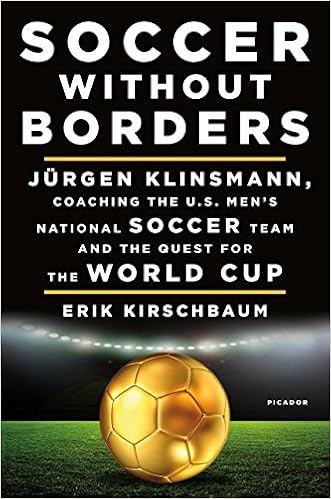
Soccer Without Borders


Erik Kirschbaum is a foreign correspondent based in Germany, originally from New York City has worked for Reuters and the Los Angeles Times. Kirschbaum is an American of German heritage working with an American viewpoint overseas, he has written a book about a displaced German in America who is changing the way the nation looks at a very European sport.

Taking on the scope of a blueprint for change of soccer in America, Kirschbaum is part biography of Jurgen Klinsmann, head coach of the United States Mens National Team (USMNT), telling the story of how his determination helped him come from a small town in rural Stuttgart to become one of the best forwards in footballing history and certainly of the last 15 years of the 21st century.

Following his retirement, Klinsmann continued his thirst for knowledge and hunger to succeed into a coaching career starting with the German national team for the home World Cup of 2006, when his influx of attacking ideology and specialist coaching led the hosts to a cruel semi-final defeat versus eventual champions Italy.

Klinsmann then leaves the role for his assistant, Joachim Loew, who taking the foundations he built leads Germany to a World Cup triumph in 2014 in Brazil, the first European team to win the World Cup outside of Continental Europe.  Klinsmann was in Brazil too, as coach of the United States and they exceeded expectations qualifying from the Group of Death with Germany, Portugal and Ghana to get to the knockout phases before a cruel defeat to a reborn Belgium.

Image result for jurgen klinsmann

The novel makes pains to realise how diligent to learning Klinsmann has been throughout his career.  Having played in Italy (Inter Milan), France (Monaco), England (Tottenham Hotspur) as well as his own country with Stuttgart and Bayern Munich, the striker would always jump into learning the new language during his time away from the training field. Klinsmann is of the belief that a player must be educated off the field as well as given all the benefit of having the best on-field training, if a career is cut short a player should be educated enough.  He makes the point that paying young players too much too early in a career would quell any desire to better their performances or hunger to improve.

Klinsmann seemingly took an American impulse for different coaches for different positions and brought them to the German national team in the run up to 2006, also the employment of a nutritionist and most importantly a sports psychologist to help with the pressure of a home tournament is the difference between margins of victory and defeat.

Since 2006, in other sports, the proliferation of sports psychologists across a whole spectrum of professional sports have been at the forefront of exceptional performances - from the British Cycling dominance from Chris Hoy to Bradley Wiggins to Chris Froome, to the resurrection of Ronnie O'Sullivan and his relationship with Stephen Peters who could take a player with little tournament preparation and win successive World Championships.

Image result for jurgen klinsmann

Soccer Without Borders, does waiver from time to time, and does repeat itself too often but it is written with genuine relish and enthusiasm for the subject at hand and the effect the person has had on his sport which is continuing apace in America.

Klinsmann has had a profound effect on world football, his application of a more attacking philosophy for Germany has filtered out into the Bayern Munich infrastructure and established the dominance they enjoy to this day, his German squad of 2006 had an injection of quality youth at his disposal - Philip Lahm, Bastien Schwiensteiger, Thomas Muller - who became World Champions; and he is making great strides to make the United States a mainstay of future major tournaments starting with the Copa America this summer which is being staged in the USA.

The book is part biography, part analysis and is an entertaining foray into unmasking a man who is equally modest and professional about his exploits.

Soccer Without Borders is out now on e-book/kindle from Amazon, but is released by Picador Books in Hardback on 13th July in the UK

Monday, 15 July 2013

The Stupid Footballer is Dead

The title is not a vendetta, and this is not a knife in the back versus the stupid footballing culture of young men getting lots of money too soon in the career.  Instead this small tome is a nice piece of intellectual and insightful piece of work by a former professional footballer.

Paul McVeigh, is a former Northern Ireland international who played in the top flight for amongst others Tottenham Hotspur and Norwich City.

McVeigh retired in 2010 after making his debut in 1996 at the age of 33.  That might sound a bit too early, yet McVeigh is now a highly respected motivational speaker and media analyst (www.paulmcveigh.co.uk) who is utilised by high ranking sides as a voice of reason and personality to speak to young players who are going through bad times.

Part autobiography, part memoir mixed in with the type of intellect seen previously in Matthew Syed's Bounce and Malcolm Gladwell's Outliers; McVeigh's book looks back on his own life lessons - such as turning up hungover for a reserve game, playing out of his skin in the first half and then hitting the physical wall after half-time.

Unlike present day players it seems McVeigh learnt from his mistakes and this is part of his theory into practice; he believes players need to put into practice mental preparation exercises as well as the physical conditioning and innate talent and skill at their disposal.

Each chapter has a mental framepoint exercise, where McVeigh mixes personal stories with mental exercises, ending with a personal appraisal of a role model. For example, Lesson Seven - Mix Intensity with Control where the author gives examples of Joey Barton, Mario Balotelli and Wayne Rooney as players who give into the red mist of anger from time to time, the role model he selects is Scott Parker.  A player who plays hard in training, and yet is a model professional off the field and like McVeigh has made the most of his ability to become a Footballer of the Year and England international.

McVeigh goes in depth with self-visualisation (which David James lived by) so players should imagine themselves scoring goals or saving them; focus on the game from day to day; by doing mental preparation it will improve your physical play.

My only concern would be when do young footballers get the time to do this self-assessment work on their own performance, players usually train for two hours a day and then go home.  Can they be expected to do this sort of homework when no-one is watching them?  He praises Paul Lambert immensely, and you can imagine Lambert was big on mental preparation for his young side as Aston Villa fought off the threat of relegation.

An especially enlightening story told is how Norwich lost at Leeds United due to a last minute mistake by Fraser Forster (now of Celtic).  Instead of reading the riot act to his side for losing all three points, he praised his side for doing so well and mistakes happen.  Forster felt better immediately, and his play at Celtic last season led to an England international call-up, Norwich then went on an unbeaten seven match run.  McVeigh's point is that by moving on to the next game and not focusing on the negative and instead focusing on the positive led to greater results.  Other managers would have crucified Forster and probably dropped him.

McVeigh says this was due to the time Lambert spent in Germany with Borussia Dortmund.  The perfect player for him would be a mixture of German mentality and technical ability of the Spanish footballers, particularly those from the Barcelona academy.

The Stupid Footballer is Dead is not a critique or an appraisal of the modern day footballer, more a plan of action to change the way footballers prepare for a game and then analyse their game to gain a further improvement. A must not only for football fans, but footballers themselves which is both accessible and riveting.

The book is out now from Bloomsbury Sport in paperback for £14.99

www.bloomsbury.com

Thursday, 20 June 2013

Easy Rider by Rob Hayles

If I was to ask you who was the most important person in the renaissance of Great Britain's track cycling revolution you would probably point out a few people to mention.  Your shortlist would no doubt contain Chris Boardman, Chris Hoy, Bradley Wiggins, Mark Cavendish and or David Brailsford.

Whilst the first four names are all either Olympic or World champions and the last name is the scientific genius behind them all with the new training regimes and analytic performance.  However, there are always the nearly men, the men who came so close to glory and yet for one reason or another failed to become the household name their endeavours so richly deserved.

Rob Hayles is one of those nearly men. In spite of being the proud recipient of two rainbow World championship jerseys for the Team Pursuit and Madison in 2005 (Los Angeles) and three Olympic medals (two bronze, one silver); Hayles' name is the type you really have to know your cycling to recognise, despite his continued involvement in the sport following his retirement in 2011 - as a training partner of Manxman Cavendish or as a commentator for Eurosport or BBC Radio.

Hayles has written a biography entitled Easy Rider: My Life on a Bike; the title is a pun of course on the seminal counter-culture film directed by Peter Fonda and Denis Hopper in 1969. Whilst Hayles whilst never an anti-hero, the title is misleading as the life and career of any top level elite cyclist is anything but easy.

Hayles started out as an amateur cyclist who quickly became renowned for his speed on the track and yet he was not averse to riding on the road as he did for French team, Cofidis, tackling long stage races on the road when a team-mate of David Millar, allowing us to hear a different interpretation of the mask of Millar who succumb to drug usage in spite of being naturally gifted and heralded as a class apart.

Hayles freely admits that he hates training, and that his laid back nature could be infuriating to team-mates who continually work hard and yet do not enjoy his level of success.  In contrast to the metronomic nature of people like Boardman who are knowledgeable and precise; Hayles comes across as a carefree soul who just loves to ride his cycle - for fun, for money, for life.

Reading about Hayles attempts to make Olympic teams, his watching the new blood come through his compelling and makes you wonder what the man would have achieved if he had been able to sustain Lottery funding for himself instead of it being granted halfway through a twenty-year career.

Hayles is at pains to make clear that without the National Lottery funding that came after the complete Great British team debacle of 1996 (when only Steve Redgrave and Matthew Pinsent won a gold medal together in rowing), Britain needed to change before a lost generation of potential was lost.

The funding allowed for more coaches, better training facilities including the construction of the Manchester Velodrome; when Hayles started there was only one in Leicester.  Now there are four nationwide including the aptly named Sir Chris Hoy velodrome in Glasgow for the 2014 Commonwealth Games, the place where Hayles fittingly concludes his book in the epilogue.

As Hayles enjoys his summit at the 2005 World Championships in Los Angeles, he is joined by a star-studded cavalcade of future talent - Bradley Wiggins, Geraint Thomas, Ed Clancy, Jamie Staff, Jason Queally, Cavendish and Victoria Pendleton.

Whilst the 2004 Athens Olympics were fantastic, the 2005 World Championships seems to be the watershed moment for British Cycling - four gold medals including the two for Hayles; one silver and one bronze giving a total of 6 putting them atop the Medal table - this would lead to the domination of the 2008 Olympic cycling programme in Beijing with Hoy's three gold medals amongst the 8 track/road Gold medals amongst 14 total - the great story goes that every member of the British cycling team flew home with an Olympic medal, except one, Mark Cavendish (who still searches for one but that's another story).

The hardest thing about reading a biography of a person whose name you may know, but be unfamiliar with, is that you have to trawl through a lot of material before you get to the good stuff such as the victories.  Hayles is not shy either to mention the drinking enjoyed by the team after the championships and why not, how often can you celebrate being the best in the world.  The book whilst a bit dour through the hard training regimes, it practically soars when the good times arrive.

Hayles writes freely and candidly letting us into his relationship with wife Vicki, a former Olympic swimmer, and how the pressure of training and competing puts on their partnership, but never making you think other than his admiration of her talent.

Whilst all biographies can be deemed as selfish, Hayles never gives the air of arrogance about his achievement - the surprise is how ignorant he is of his place in the vanguard of British cycling, every sport needs trailblazers who capture the imagination of the many and the respect of his peers.  Hayles has many friends that still compete, they should be grateful that he was there 20 years before them to make sure they have the platform and innovation of training to make them fulfil their potential, something but for a bit more luck would have done so himself.

Easy Rider: My Life on a Bike by Rob Hayles is released by Transworld Publishers on Thursday 20th June for £16.99 rrp

Hayles wrote the book in conjunction with Lionel Birnie, who covers the Tour de France for the Sunday Times and writes for Cycle Sport and Cycling Weekly

Thursday, 13 June 2013

The Gaffer - Book review

Released in time for Father's Day, Neil Warnock has released a book entitled The Gaffer: The Trials and Tribulations of a Football Manager.

The book which can be considered Warnock's first public statement since he departed Leeds United is a look back on his career throughout football via the big moments of his career from guiding Sheffield United to the Premier League, to the fall-out of being relegated and the ensuing Carlos Tevez saga which ultimately cost him his job.

Focusing primarily on the time at his QPR and the money involved with the club, Warnock is keen to stress he holds no ill will towards the owners who sacked him but would be more inclined to focus on the privilege in guiding the club from near relegation the previous season to table toppers helped by such talent as Adel Taarabt, Heidar Helguson and Jamie Mackie.

Warnock's tone throughout the book (helped by Glenn Moore of the Independent; for whom Warnock wrote a weekly column which was as entertaining as this title) is one of eternal optimism, you get the sense that Warnock loves doing the job he does, and for every job he loses due to poor form or new owners, he is reflective on the job he has done has been to the best of his abilities.

Warnock comes from the same school as Harry Redknapp - not the greatest of players during the playing career but a man who has a keen observation of tactical formation and man-management. Warnock mentions how he used speed of his youth team at Crystal Palace to good effect prompting the promotion of John Bostock and Nathaniel Clyne amongst others to the senior side; Warnock set the framework by which Palace continue with Wilfred Zaha at the forefront of Palace's promotion season.  Warnock's belief was that these youngsters need to play games before moving on to bigger clubs, where they will stagnate and plateau - a telling remark in light of England U21s disastrous European tournament.

This may be a view of one man on his life in football, and at times like most biographies it can be self-congratulatory yet Warnock's joie de vivre for life and football does come across mostly; his numerous famous interviews made him appear to be a man you would like to sit down with for a pint.  This book does not disappoint in that respect, and his chapter on refereeing standards is both enlightening and eye-opening.

The Gaffer is a perfect gift for Father's Day, for a no-nonsense account of life as a somewhat scapegoat in a business first approach to football.

The Gaffer is out now from Headline Publishers at £16.99 and is also available as an e-book.

www.headline.co.uk

Monday, 27 May 2013

Court Confidential

Neil Harman, is a renowned and highly respected Tennis correspondent for The Times having previously held the same post with the Sunday Telegraph and Daily Mail.  Mr. Harman releases his new book Court Confidential: Inside the World of Tennis, published by The Robson Press.

Court Confidential is a year in the life of a tennis correspondent, as our man travels from continent to continent, country to country, surface to surface following the great names of the modern era - Novak Djokovic, Rafael Nadal, Roger Federer and Britain's own elite sportsman, Andy Murray as these men chase titles on grass, clay and hard courts for the prestige of the number one World ranking.

Starting in December 2011, with the announcement of Andy Murray's newly appointed coach, Ivan Lendl, up to the end of the momentous year in 2012 which saw Murray lay to rest the ghost of Fred Perry with both his first Grand Slam title and Olympic Gold on home turf during London 2012.

However, this is not just a book about the rise and ascension of Murray to the summit of tennis, but Harman uses the book to show us details of behind-the-scene information of which is not normally divulged in daily tennis columns and feature pieces and gives good scope for both the men's and women's game - his coverage of the women's game comes across as respectful and admiring especially his close relationship with Victoria Azarenka.

Journalists used to write books like this all the time, an expose about the 'real' tennis as a means of getting a message across.  Unfortunately, those books (mostly in football and ghost written) would descend into gossip material, however, Harman uses his unique access to paint a picture of a sport still evolving with the demands its success has breed - having to deal with the gruelling year-long schedule, his conversations with Justin Gimelstob show a player's reprsentative on the ATP board desperate to save the players from this treadmill - especially the top four - before they succumb to injury and burn-out, as is apparent with the disappearance of Nadal from the last 100 pages of the book owing to his continual knee problems.

One telling contribution amongst the many interviews conducted by such big name contacts (a fact that never becomes sheer name dropping), is the email sent to him by Amer Delic, a Bosnian by birth now of American citizenship, which highlighted all the monetary downfall of playing Grand Slam tennis such as the Australian Open in Melbourne in January.

Delic reacts to those who criticise as to why players who lose a first round Grand Slam match are guaranteed just under $20,000.  In two paragraphs he explains how a player loses 30% to tax leaving him $14,000. The minimum $3,000 round trip from Los Angeles to Melbourne in economy, which is costly but also physically arduous for a 6' 5" tennis player with a surgically repaired knee. You add on a ticket for his coach, three weeks of hotels at $100 per night plus food per day means the average player is down $1,120 by the time he returns to American soil.  He jokes that it would be easier to declare himself a charity or a non-profit organisation.  Sadly, Delic retired from the professional tour in August 2012 and is now assistant coach at the University of Florida.

Harman takes you back to those amazing two months in Andy Murray's career when he became the first British man since Bunny Austin to reach the Wimbledon final only to lose to a resilient Roger Federer, then to return to Centre Court three weeks later to oust the Swiss for the Olympic Gold medal in straight sets no less with incredible poise and strength.  Then the piece de resistance in Flushing Meadow, New York when Murray beat Novak Djokovic to win his first Grand Slam title.

Reading Harman's prose is very different to that of his Times reports.  Whilst the Times writing comes across as a voice of authority and distinction; in the book in general there is a real joie de vivre about the whole proceedings and you get a real sense of Harman personal sense of pride and satisfaction in witnessing Murray's victories on this scale having had to suffer so many near misses with Greg Rusedski and Tim Henman, followed by the lack of funding for a sport that is so beloved in this country.

Harman is not just a reporter, most importantly his voice as a fan reads loudest - his passionate voice and belief that the Lawn Tennis Association should not waste this obvious opportunity to cement Murray's legacy and influence to make sure he is writing about other future British champions for years to come.

The book is a wonderful gift to not only Tennis fans but sport fans in general and those who want to see behind the enigmatic characters that intrigue us for weeks throughout the year -

The best complimetn for the book and a metaphor that Mr. Harman would approve of is - Court Confidential as crisp and neat as a Stanislas Warwinka one-handed backhand, and just like that shot it is a winner.

Harman's book is ultimately timely and in future years will become a veritable time capsule book for future generations of this memorable golden era of tennis.

Court Confidential is out on Monday 27th May from The Robson Press fror £20 RRP in hardback and also available in e-book format from all the providers.

Follow Neil Harman on twitter @NeilHarmanTimes
Follow The Robson Press @TheRobsonPress