Showing posts with label British writing. Show all posts

Thursday, 24 January 2019

The Hunting Party


Lucy Foley's debut thriller is set to be one of the great thrilling reads of 2019


British crime novel writing is going through a vanguard or renaissance period currently, be it from the loner detective in Joseph Knox's Manchester set crime novels; to A.A. Dhand's Yorkshire set crime epics; and there is great representation by Fiona Barton from the female writers of these shores.

Set over a New Year's weekend of celebrations, Foley takes her protagonists away from their sheltered happy self-important London existence of wealth and privilege, dropping them into a remote part of the Scottish Highlands where they hope to engage in fun and frivolity over the four day weekend.

From the outset, the nine people she gives to us are of a millennial sort - highly educated having all met at university in Cambridge, in great employment and a better life than Riley.

The hope is that this is one last hurrah for the group before children and other responsibilities stop them in their tracks; and yet a swift blizzard puts pay to that as cabin fever sets in and the abundance of alcohol brings up resentment and old secrets amongst the group.

Atmospherically set amongst the vast landscape of a cold bleak Highland setting, Foley cleverly weaves an ever-changing narrative flash forwarding and backwards amongst many of the characters, this offers us different voices to listen to prompting quite a challenge for the debut author to maintain this flow of narrative.

From prissy Miranda, to quieter Katie, to lodge host Heather and gamekeeper Doug; Foley writes confidently in all these voices garnering quite a range of motives from all.

The anticipation for this novel has been met by the finished article here, and it is great to see a riveting example of crime fiction by a British female in the same vein as American Shari Lapena, Foley will be able to be heralded in the same company as Fiona Barton on the evidence of this first stab at crime novel writing.

The Hunting Party is out now Harper Collins in Hardback, Ebook

Thursday, 20 December 2018

Our Life In A Day - Jamie Fewery


The debut novel from journalist Jamie Fewery, takes a unique narrative concept to tell the story of a relationship over 10 years.

Esme and Tom, meet by chance at a fancy dress party - they are the two who have not bothered to get dressed up so immediately there is a kinship bond between the two of them, a common footing from which to spring off.

That night Tom escorts Esme home to her flat south of the river, this walk they get to know each other and they agree to meet the next day. A relationship is blossoming.

Fast forward to 10 years later, on the day of their 10th anniversary, as a treat Esme decides to play a game where Tom has to come up with the story about their life together. 24 post-it notes, one signifying one hour of any hour of any day from the last 10 years - so we embark upon a flash backing and jumping around narrative where we encounter surprise birthday parties, Christmas get-togethers, long disruptive car journeys that paint the picture of a partnership and the obstacles that society can thrust upon you such as parental passings and the past that hangs around you.

While comparisons will be drawn no doubt to David Nicholls' One Day, this is an altogether different book which does not have the unnecessary ending Nicholls' book had which redeemed the quite frankly awful character of Dex.

Fewery has taken great care in constructing two lead characters who are fully rounded and while they have negatives and drawbacks, the realisation is 'don't we all'.  Tom is flawed in that he has his demons from his university days, attempting to deal with the pressures of uni life by drowning his sorrows too much and forcing himself to make a terrible decision.  That decision comes back to haunt him and his rendering is one of the better ones to show the pain of mental illness in young men, a portrayal rarely seen in literature and goes hand in hand with the current social groundswell taking place.

Esme meanwhile is written beautifully, like women in fiction she is stubborn, forthright and opinionated but loyal and faithful to Tom to a tee.  In the inevitable adaptation, you can picture Emilia Clarke (Game of Thrones) taking on the mantle of her role.  We are now past the manic pixie dream girl and landed in the land of beautifully stubborn young lady.

Fewery writes with a conciseness and clarity, I read the book in less than a week ripping through chapters at will. He has created two very rounded characters - a forthright female with her own ambitions and stubborn as hell, while in Tom he has written a man who has his demons and is wary to share them.  This is a great portrayal of mental illness; we as men need to open up and share our problems - when you communicate openly you can share the burden but also find some resolution and consolation in being honest about how you are feeling.

This book will garner a great audience and is a lovely book to purchase for Christmas; this is a book written for both sides of the argument, this is not a book solely written by the male gaze instead it can be considered a metrosexual novel of an altering relationship.

Our Life In A Day is published by Orion Books on 27th December 2018.


Wednesday, 20 June 2018

Corrupted by Simon Michael


Published by Urbane Publications on Paperback on 21st June, Corrupted is the fourth book in the Charles Holborne series


Having never known of the Charles Holborne series you fear that you may be late to the party, much like the swinging dance parties and afternoon teas that take place at the Ritz in 1964, the year in which the latest Simon Michael novel is set.

There is no fear of that though, Michael has been lucky enough to create a central protagonist in the same vein as Jack Reacher; a likeable everyman who is one step ahead of most people, but one who is not afraid to throw punches (literally) nor get his hands dirty in the eternal pursuit of justice and truth.

Charles Holborne (or Horowitz - to show his birth name, and the still relevant anti-Semitism taking place in London), is 39 a Barrister working in Chambers at the Temple and the Old Bailey, he presides over a variety of cases - yet he himself has a criminal past which will not let go of him. He is well liked by his peers, colleagues and his unwillingness to fall in line with the old boy network does ruffle feathers, he nevertheless gets results.

The book is set in a hot summer of 1964, a year where the Beatles are returning home from conquering America, Sonny Liston just lost to Cassius Clay and the beginnings of the sexual revolution are slowly fermenting around the swinging London scene.  We first encounter Charles at home with his partner Sally, having recently moved in to a new house in North London; even Charles moans about the commute to work.

Upon his desk though comes a case involving his old nemesis, the Krays twins; the legendary Ronnie and Reggie whose criminal underworld dealings were known and held a vice like grip over London's night life.  The Krays are at war with the Mafiosa, and this leads to a footsoldier Mo Drake being murdered at his home supposedly by the Italians in revenge; yet there is more to the case than meets the eye.

It had long been rumoured for some time that Reggie Kray was homosexual and he was played as such by Tom Hardy in Legend as such; and yet the narrative revolves around a scandalous sex party that takes place at one of Reggie's residencies in Walthamstow, where all manner of high profile dignatries and cabinet members including Lord Robert Boothby attended indulging in fornication and sexual conquests.  In the narrative, a runaway boy Teddy is taken in by Mo and attends the party leading to Mo's death later that same night.

Charles takes on the case to clear the boy whom has been arrested for Mo's murder; yet Charles also has problems at home with Sally (who sadly vacates the scene somewhat abruptly) as Charles will not relent on his dream of fighting in the boxing ring one last time before his fortieth birthday, following a successful amateur career.   Charles goes for long runs on Saturday mornings and sometime evenings, which allows the author to write fondly of London before overpopulation took hold.

Even the premise of placing historical figures such as the Kray twins and all the mythos and legend they carry with them does not restrict nor overawe the character development of Charles Holborne, our protagonist remains front and center and the heart and soul of the book; you never feel your allegiance being swayed by the celebrity gangsters who themselves are written with great clarity and care by Michael, not becoming these overbearing larger than life figures, merely important people doing their job like anyone else.

Author Simon Michael

That is the beauty of this book, for all the gripping thriller elements and the page-turning quality of the narrative that rips along as quickly as that of Child or Grisham; Michael has gone to great lengths to paint a vivid picture of London at that time, as if it was the centre of the world - the glamour of the Ritz, to the stuffy tradition of the Old Bailey.

There is a vibrancy in the writing from the back and forth dialogue from each colourful character Charles meets to the vigour of the scene-setting of nightclubs and bagel shops, you feel a part of the story - something that this reader has not felt for quite sometime.

And with the protagonist Charles, Michael has created an anti-hero who is very much of his time - a chameleon like individual who is changing with the times much like his own city and world is in flux itself in terms of the rise of sexual freedom, feminism with Charles embodying the new breed of outsider and non-public schoolboy combating prejudices daily in his professional career; something the author had to confront during his career as a barrister.

As mentioned, the books 420 pages rips along at quite a clip that you will would be wanting more and with there still six years left in the 1960s for Charles to indulge in, it promises for more yarns for Michael to tell.  This reader for one will be looking back at the three previous installments of the series and looks forward with relish to the rest.

Corrupted by Simon Michael is released by Urbane Publications on 21st June.


Tuesday, 12 June 2018

In The Wake - Helen Treverrow


Helen Treverrow's debut novel is released from Urbane Publications on 28th June


When a body is found floating in London's Royal Albert Dock, public relations expert Kay Christie is sent to quiet the media, but things become complicated when it emerges she knows the victim.

Centered around the Excel center in London, a major exhibition is overshadowed by this body being found.  A convoluted narrative structure involving Kay's father who works at the exhibition hall, and the tightly knit support network around her starts to unravel as secrets much like the body rise to the surface.

Opening with the disappearance of a French nurse from her London hospital around Christmas time - the imagery Trevorrow evokes the harshness and cold of the London winter is depicted succinctly, showing the combination of how lonely the big city can be when you are questioning your own decisions in life.

Kay is in her 40s, gay and partnered with Julia, a woman who is enjoying an Indian summer with high-profile media commitments; and yet Kay is not happy. Kay drinks regularly, she is in love with her job but not in love with her routine. The introduction of a female police officer, Polly - younger and vital stirs some lustful yearnings within her which has been absent for sometime.

This melodramatic shift to a women's narrative in unison with the crime story is a risky venture, and on occasion the crime story struggles to be heard beside the Sapphic storyline; at times this reader felt that the love scenes were overpowering the actual crime story narrative and the interest in the case being solved.  Kay is an intelligent, successful woman and yet her life is full of quandry with Treverrow delicately explaining her psyche following a sexual assault from years past; which is told to us in flashback.

Wednesday, 14 March 2018

Hangman


The highly anticipated sequel to Ragdoll by Daniel Cole, has a lot to live up to.  When we finished Ragdoll, the hero Wolf had fled the scene following his colleague Baxter's decision to let him leave the crime scene.  Wolf has gone underground and no-one has seen him, we find Baxter now two years after the end of the Ragdoll murders and the numerous copy cats.  Now there is a new mass murderer who is taking bodies and having them hang from great heights with the word 'BAIT' scored into the torso of the mainly male bodies.

Baxter and her team, including the returning Edmunds have to work with new friends including the ex-pat Rouche, a man born in England but working for the CIA in America who is as disruptive as Wolf was but just as conflicted.

The book has the feel of the writer spreading his wings, but whereas the first book had the social context of fear and panic of unknown attackers on the streets of London, with the media spinning people into a frenzy for their health and safety; this novel though has the feel of being a lost love child of Dan Brown.  Extensive plotting with twists aplenty, by the book characters with little in the way of emotional connection and elaborate set-pieces of action and gore being given precedence over telegraphed dialogue.

This reader feels that following the high-octane, gasping intensity of Ragdoll this is a step backwards although the (very) late introduction of someone means that another book is in the offing and this return to the mean may hopefully incite a return to form.

Cole is a writer who clearly likes to take risks with his writing, compounded intentions and expectations of his readership but for this reader it seems to have come up short to the level of what Ragdoll was, my hope is that the expected third book is a return to that thrilling form.

Hangman is released by Trapeze Books on 22nd March

Wednesday, 7 March 2018

The Smiling Man

Image result for the smiling man joseph knox

Joseph Knox, got tongues wagging when his debut novel Sirens was released by Transworld Publishers in early 2017. The tale of Detective Aidan Waits' descent into hell as he succumb to his drug addiction whilst attempting to complete a criminal investigation; was a tale for our times, an anti-hero who wore his vices clearly - at times unlikeable, dishonest and yet equally charming and mysterious.

Waits returns in the sequel or second of the ongoing series, The Smiling Man.  Waits has now been banished to the graveyard shift with the only officer who would work with him, a large unsavoury character Sutton - who uses hand sanitiser religiously, it dripping from him like fat our of a chip pan.

Whilst this reader was fond of Sirens, the malevolent nature of Watts was something difficult to deal with - whilst it harked back to the bygone age of literary pulp noir such as Hammett and Chandler; their heroes Sam Spade or Philip Marlowe were certainly capable of bad things they never crossed the ethical line Waits practically triple jumped over.

The Waits we encounter in this second novel is an altogether different character, one who is aware of the harm he has caused and damage to his reputation and close relationships.  Now sober but stuck in a shift he can never get out of, investigating the thrilling world of dust-bin fires he fears he will never see the light of day until they get a call to the Palace hotel late one Saturday night.

There they see a security guard injured and further investigation leads them to a fourth floor room (413) that has a man tied up in a chair dead but with a Cheshire Cat grin on his face.  This unnerves Waits and the veteran Sutton, and so begins the case to find out who the Smiling Man is or was.

Waits encounters obstacles throughout and not from criminals but as much from his superior, the omnipresent Superintendent Parrs who has his sights set on Waits and would like nothing more than to put him out of the picture.

While the first book wallowed in the dark world of Northern Noir it was drawing, this book is lighter in tone due to a sober Waits being front and centre; his charm and magnetism coming to the forefront - though a bar-room brawl with a former enemy brings out the worst in him.

Image result for the smiling man joseph knox

Whilst Knox focused on creating an atmosphere of noir in the first book, this is more of a tongue-in-cheek noir transplanting the talking of American noir to Manchester; oneupmanship banter flowing back and forth and with the action taking place over summer months there is a general warmth and sunny disposition running through the novel but always with that sinister underbelly ('Fate turns into karma at forty degrees')

Yet that is the cleverness within Knox's writing - the consistent juxtaposition of light and dark; good and evil; right and wrong; the warmth with which Waits is created is merged with the dark of the world he inhabits.  There is a lushness and rawness to the novel that radiates throughout and its a pleasure to read and see a young writer growing in confidence with each new work written.

The Smiling Man is published and released from Doubleday Press on Thursday 8th March


Monday, 10 July 2017

Interview with David Barnett, author of 'Calling Major Tom'

IMG_1168
Author David Barnett of 'Calling Major Tom'


Calling Major Tom is one of the most highly rated and beloved books of 2017, following its paperback publication from Orion Publishing on Thursday 29th June, NextToTheAisle was granted an interview with the book's author, David Barnett.


- What was the genesis of the book?
Well, I’ve mentioned this several times before, but the main inspiration came from a true-life event when the British astronaut Tim Peake made a wrong-number call to a grandmother in the UK at Christmas 2015, which amused me and made me wonder what would have happened if that conversation had continued, which is the basis for Calling Major Tom. But I suppose the real-life story behind that is the fact I was made redundant from my job in summer 2015 and embarked on a freelance journalism career. When the idea for the book came to me and I started discussions with Orion, who were setting up their new imprint Trapeze, it meant I was in a good position to devote the time to writing the book.

Image result for calling major tom david barnett


- Where did the idea for a fish out of water come about, by plot, by character?
I knew Thomas was going to be incredibly grumpy, and I knew that he needed to be away from everyone else, so that was the starting point. But I also knew that readers tend not to take to a character who’s curmudgeonly for no reason, so Thomas had to have had a life that had led him to being like that, and unfolding the reasons for his grumpiness formed a big part of writing the novel.

- I first heard of your book, a few months after David Bowie's passing, was this an unlikely accident or did you re-edit due to his passing?
No, it all came about at the same time, really. The Tim Peake incident happened just a couple of weeks before Bowie’s death, and when the latter happened - like Thomas in the book, I awoke on my 46th birthday to hear the news - it all seems to fit seamlessly together and helped to formulate Thomas’s character. He’s grumpy but he’s not a monster - he has excellent taste in music, and Bowie’s death, along with some more personal bad news, is one of the motivating factors that propels him into the position where he becomes the first human to make a solo mission to Mars.

Image result for david bowie
David Bowie, the original Major Tom

- How long did the whole process take?
It was very quick, really. Because the idea consolidated itself very quickly I was off and writing at the beginning of 2016 and I think I’d delivered the finished manuscript by the end of July, with obviously some copy edits after that. But the ebook was released in January 2017, just shy of a year that I’d first begun conversations with Sam Eades at Trapeze about the idea.
- You have a good sense of character and dialogue of differing ages of characters, how did you capture that?
I think as a writer you have to be interested in all kinds of people, and observe them, and take notice of them. We usually all have family, friends, work colleagues, neighbours etc of varying ages, social classes, ethnicities etc etc and it’s just a case of being interested in people. All the best fiction is about people, and a good writer really needs to be able to get under the skin of all kinds of people to know what makes them tick.

- David Bowie hangs over the book and provides a soundtrack as you read, what other influences did you have?
Music was important - in fact, I recently put together a playlist of most of the music referenced in the novel (including Chris De Burgh’s Lady In Red… that was from another character, Thomas would be appalled). You can find it here: https://davidbarnett.wordpress.com/2017/06/26/calling-major-tom-the-playlist/. But I think I wanted the novel to feel as contemporary as possible, so there are references to Brexit etc. But one of the biggest influences was my hometown of Wigan. That’s where the Ormerod family who Thomas makes contact with live, and I wanted to try to portray a working class family as ordinary, normal people… so much of contemporary fiction seems to focus on middle class characters, I wanted to show the lives of people like those I grew up around.

Image result for tim peake
Tim Peake's accidental phone-call supplied inspiration
  
- How pleased have you been by the response to the book?
Well, it’s early days yet, as the paperback only came out at the end of June, but the response to the ebook was phenomenal. I was amazed at how much of a chord the story and characters seemed to strike within a wide range of people, and there were some utterly fantastic reviews (such as yours!) from book bloggers, who I see as an absolutely vital part of the book culture for getting the word out about books to readers.
  
- You come from a journalism background, do you find the key to avoid block is to keep writing in any format?
Yes, the day job is still freelance journalism, so any given day will find me writing features for the national newspapers and magazines, working on fiction, doing a bit of lecturing at a local university, so I’m always writing, and while the writing isn’t always fiction, it’s like exercise. If you go to the gym you might do cardio or work different muscle groups, but it all contributes to overall physical fitness. It’s the same with writing. Journalism and fiction use different writing muscles, but ultimately it’s all writing, and that’s what’s important - to keep writing.

- What are you working on now?
I’m working on a new novel for Trapeze, which is called The Lonely Hearts Cinema Club, and which will be published by Trapeze in summer 2018. It’s set in a quirky rest home on the Lancashire coast, which takes in students to fill empty rooms and make a bit of money, and is a bit of a mystery, a bit of an inter-generational clash, a bit of a story about loneliness and growing up… or not.


Calling Major Tom is out now on Paperback from Orion Books
Follow David Barnett on his website www.barnettmedia.co.uk/ or on Twitter @davidmbarnett

Wednesday, 14 June 2017

The Things We Thought We Knew


Debut novels come and go, every writer has one inside of them. Some writers come later in life, some come after years of writing at university. Sometimes they come from the spirit of youth.  Mahsuda Snaith is one of those youthful writers, who wrote a novel first draft at the age of 16 went to university and returned to it finding amongst the cringeful first draft errors only experience would notice, a book that was full of well-rounded characters.

The Things We Thought We Knew, tells the story of Ravine, a young British Bangladeshi woman who lies in her bed plagued by chronic pain syndrome following the disappearance of her friend Marianne. They were best friends yet Ravine is trapped to her bed. The novel follows the belligerent mother, Amma, who will not take a no for an answer from her daughter, prompting her to get out of bed and vote knowing she is capable of progress.

Mahsuda Snaith | 'I'm British Bangladeshi, and I never came across many books from that perspective'

"Council estate life has been represented in literature before, but always in a very dark, gritty way. That just wasn’t my experience of growing up on a council estate: it wasn’t all doom and violence and drugs, some of the stuff I came across was quite comic, so I wanted to reflect that.”

Ravine is drawn as a rebellious teen who wants to remain in her fixed state and not alter her surroundings.  That is what the book is about, change and how it changes people around it. Starting at Ravine's 18th birthday party and the impending election she can vote at, Amma makes a beeline to change her domestic surroundings and move Ravine from her funk.

Written with delicate nuance with clever observations of familial relationships and interpersonal behaviour, the book is also about recall and memory - it easily could have been placed in the same genre of The Fault in Our Stars by John Green, yet this is set in a Leicester council estate which gives the book greater character and realism than Green's wonderlust piece.

Snaith's debut novel is one that will contain something for everyone and wish more books were written such as it.

The Things We Thought We Knew is released from Penguin Random House on 15th June in Hardback/eBook

Tuesday, 9 May 2017

Blue Gold - book review


Published by Urbane Publications and due for release on 11th May, the debut author by David Barker Blue Gold tells the story of a future world where water is at a premium, a commodity that territories fight over and lives are lost over the ability to drink clean water.

Barker is a part-time economist, who has turned his hand at novel writing and he has successfully crafted a page-turning tub thumping action adventure that is fun to read and shows a real potential. 

Our hero is Sim Atkins, (he goes into why he is called Sim and not Simon) a data analyst for OFWAT, the Government agency for Water regulation, who gets summoned to the Overseas Division after becoming aware of unusual activity from his satellites.  Swiftly Sim is thrust into an odd couple/buddy relationship with Freda, an older female who has a limp as well as emotional baggage and does not welcome the burden of a bothersome partner.

In the same vein of Indiana Jones, James Bond and Bourne, the pair globe trot from Biggin Hill to Brazil to Mount Rushmore to China to the Himalayas.  They encounter many individuals including the brilliantly monikered Bo Brunswick, where swords are crossed and backs stabbed.
David Barker
Author David Barker's debut
Being British, Barker writes with a particular tongue in cheek imbued by the youthfulness of Sim - who is not familiar with any film from before Star Wars quoted by his partner - coupled with the older more mature Freda, who acts like she has seen it all before yet still keeps her cards close to her chest.

The set pieces and fight scenes are easy to follow and have a zip that reminds you not only of Dan Brown but the far superior work of Matthew Reilly who wrote huge elaborate action adventures with subtle characterisations in unison.

Urbane Publications are a new voice in the big world of publishing, but they continue to strike gold with these new authors with voices and stories to share not only on a small scale but ones that can travel and translate. 

Blue Gold informs us of a world where water levels will rise, water will be in such high demand that people will store ice from each other and it is thought over like oil has been in the late 20th century.  It is a neat twist on a familiar geopolitical tension in the current climate.

Blue Gold will be published by Urbane Publications on 11th May

Wednesday, 19 April 2017

What Alice Knew


This intriguing novel by T. A. Cotterell tells the story of Alice, a faithful wife, whose love for her husband is sorely tested by his indiscretions one night.  Set in the Bristol area, it follows on the footsteps of other novels I have read this year set outside of the Metropolitan hub-bub of London such as Oxford for We All Start As Strangers and the grim drabness of Manchester in Sirens.

Alice is a portrait artist, married with two children beloved in the area and a model of maternal nature. This is put to the test by her husband's may or may not be adulterous behaviour which may or may not have led to the death of a flirtatious admirer.

The novel hopes to be a gripping thriller in the same vein of keystone texts such as Gone Girl and The Girl on the Train, and yet this was a book this reader found hard to get through.  The combination of somewhat implausible plotting, the hysterical nature of the faithful wife losing her mind and sometimes unnecessary art history lessons.

By the final 70 pages when Alice goes to visit her mother do you understand the psychology of Alice fully in that she wants to please everyone and people take advantage of her grace from her bitter mother to her awful siblings who live far away from her as well as the home in Scotland.

The ending felt a bit contrived and rushed unfortunately, but then again the plodding nature of the plot to begin with perhaps the writer wanted to get away from these characters he created. A potential pivotal standoff with an old school mate for Alice when she paints her portrait is handled muddily and instead makes Alice even more vulnerable and this weakness does not enforce our sympathy but instead pity; not something you ever want to extend to someone.

At times the book felt like it wanted to say so much, but was unable to due to the weakness of the protagonist and the ending where she attempts to fall on her husband's sword is both ill timed and messy.

A shame after a strong opening that this book could not maintain the focus nor the attention of this reader.

What Alice Knew is released in Hardback/Paperback by Black Swan (Goldsboro Books) on 4th May

Monday, 10 April 2017

A Monster by Violet


The debut novel by Laura Wake is a gritty to the bones drama about a young girl, the eponymous heroine who we follow on a week in her life.

Violet has abducted her best friend's baby, Maria. Her friend is an addict and the child would likely have died in her care, so doing what she thinks is best for the child and perhaps hopeful of starting afresh herself, Violet takes the child and withdraws what money she has in her account and heads for the Isle of Wight.

We follow Violet as she becomes a born again person doting on Maria and her feeds, looking after her and realising that she has to leave the temptations of drugs and addiction behind if she is too care for the child.

Violet thinks she can have the best of both worlds taking Maria to a house party that goes wrong when a snake is thrown into the mix and she has sexual contact with some other girl's boyfriend.

These dark episodes are merely the lead narrative, running parallel is the flashback to Violet as a ten year old and how she become a troubled teen and young adult; her home life is good but following the cot death of her younger brother she starts to rebel and her parents marriage hits the rocks.  There is also the unsettling storyline of a female teacher attempting to make Violet good again, which could have been construed as grooming in another plot.

However, Wake is better when following Violet and Maria on their journey around IoW yet the novel does somewhat lose its way nearer the novel's conclusion when they abscond a boat and head for France with a Portugese waiter, Sergio for company. On the boat, Violet's demons come to the fore and her paranoia regarding being possibly followed nearer brings down here downfall.

The book has good moments, especially as you see Violet becoming more maternal and the blossoming friendship between her and Sergio is nicely handled; yet the flashback storyline is dropped somewhat abruptly and does not fully explain her addictive future nor what her relationship with her parents is.

Some critics feel she is an abhorrent lead character, I think of her as reminiscent of the lead character Lily, Agyness Deyn played in the little seen film Electricity.  A smart girl who has her own mental demons to overcome, and is lost in the big bad world and is always attempting to run away from it.

A Monster By Violet is out now from Urbane Publications

Thursday, 16 June 2016

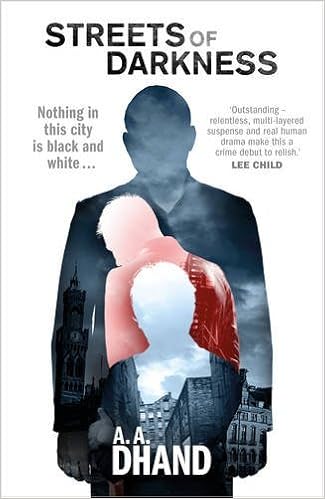
Streets of Darkness


Born and bred in Bradford, A. A. Dhand is a befitting example of write what you know. Dhand has written a gritty and gripping thriller for his first book entitled Streets of Darkness, featuring a new anti-hero Detective Harry Virdee. 

Harry (or Hardeep) is suspended when we meet him, yet enlisted to help with a murder enquiry off the books to save his career. Harry has a lot going on in his life, his Muslim wife is expecting their first child and his marriage is a question of contention as Harry is a Sikh and mixed faith marriages are frowned upon in general especially in such a sub-contential bastion as Bradford is. The mixing of faith, religion and politics is one of the key storylines running in the book.

Image result for a. a. dhand author
A A Dhand, the author of Streets of Darkness

The book is being pitched as a mix of the questionable hero like Luther and the hard nose naturalism of The Wire, and in Dhand's prose he does not hold back writing very graphic descriptions of drug use and violence seemingly paramount within the day in the life narrative. 

Mixing many tropes of the thriller genre - race against time, rivals from different backgrounds having to work together and put differences aside, are you on the right side of the law - Dhand writes with a crispness and pace that is good to see in a new British writer following in the footsteps of Lee Child, who many think of as a naturalised American.

Dhand writes with intelligence about religion and respect to his home town yet never wavering from his zest for character and narrative.  He has a keen eye for observational detail in characters be they periphery or central, and can inject little details such as when Harry sneezes when he enters a disused boxing gym due to the swirling of dust, a small detail that is sometimes overlooked in bigger thrillers on page and screen.

The film rights have already been optioned, and if they can find the right actor of Muslim hertiage then perhaps they can have a great series or film on their hands. My call to play Harry would be Arsher Ali, while he plays socially awkward characters or insecure souls, he has a bit of recognition in terms of his appearances in Line of Duty and The Missing, and if he can beef up a bit then he has the range to do Harry justice.

Image result for arsher ali images
Arsher Ali is Harry Virdee

Streets of Darkness is both page turning and can leave you wincing at the bleakness of human nature, but in this day and age it is good to see a book that is entrenched in reality and not sugar coating such matters as inter-racial marriage, race hate crimes and political corruption.

Streets of Darkness is released by Bantam Press on 16th June for £12.99 in Hardback and £7.99 on Kindle

https://www.penguinrandomhouse.co.uk/publishers/transworld/