Showing posts with label Horror. Show all posts

Tuesday, 18 August 2020

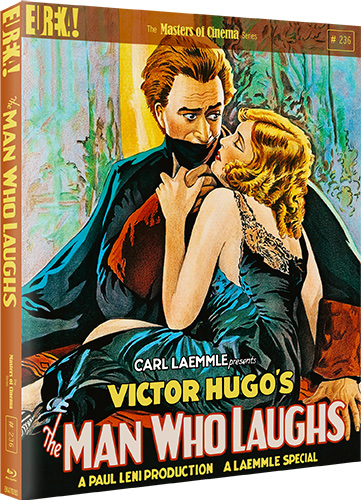
The Man Who Laughs


Released from Eureka Entertainment, this classic silent film garners a new restoration in 4K as a part of the label's ongoing Masters of Cinema series.


Made in 1928, the film was made by Paul Leni famous German Expressionist director from the early 1920s and his cinematographer Gilbert Warrenton who had made The Cat and the Canary (1927). This film is considered an early entry into Universal Studios now famous purple patch of horror movie classics under the stewardship of producer Carl Laemmle. From the studio head down, along with art director Charles Hall and make up guru Jack Pierce this collaboration was married with a defining performance at its centre by Conrad Veidt.

Veidt plays Gwynplaine, a carnival performer whose face is mutilated into a permanent ghoulish grin by his executed father's royal court enemies. Gwynplaine struggles through life with blind Dea (Mary Philbin) as his companion, and despite his disfigurement Gwynplaine still considers himself unworthy of Dea's affection.


The make up on Veidt's role has been acknowledged as direct inspiration for the first portrayal of the Joker in the DC Comics of Batman in 1940 and has become common place in screen portrayals through the years culminating in Heath Ledger's Oscar winning turn in The Dark Knight (2008).


Featuring moments of humour, tragedy, doomed romance and swashbuckling fight scenes, The Man Who Laughs remains as one of the most stylish entries into the American silent cinema era. With the sound era about to burst prominently onto the scene and the monsters of Universal pictures being able to talk come 1930-31 with Bela Lugosi as Dracula and Boris Karloff as Frankenstein's monster; it is wonderful to see the richness and detail within the film's production from costume to sets to narrative construction.

The film has been restored from Universal's 4K transfer to Blu-ray and features a score by the Berklee School of Music along with featurettes by horror expert Kim Newman and a booklet by Travis Crawford and Richard Combs.

The Man Who Laughs is available now on Blu-Ray from Eureka Entertainment

Thursday, 27 September 2012

Berberian Sound Studio

Peter Strickland turned many heads in 2008 with his debut feature, Kaitlin Varga, a film that premiered at the Berlinale and was memorable for the bold use of naturalistic lighting throughout the production of a film that was in essence a rape revenge thriller.

Strickland has comeback to the fold with an even bolder and more ambitious project, but this time produced at Three Mill Studios in West London.  Strickland was teaching English as a foreign language in Hungary, and found money for his first feature by using his family's inheritance.  This time he has found backing through the UK Film Council and Film4 for this his second feature.

Strickland has written a piece about Gilderoy (Toby Jones - in a rare leading role) an English foley artist, who has been transported to somewhere in Italy to work on post-production of a giallo horror picture directed by Santini (Antonio Mancino) where he works under the watchful eye of producer Francisco (Cosimo Fusco) a man who would love to be in charge but does not have the vision.

From the off, Gilderoy is on the back foot.  An Englishman in a foreign land without a grasp of the native language, he is told to be more polite and courteous to his hosts.  Santini is affronted by the notion of Gilderoy stating the generic context of the film, 'Never call my picture a horror picture.  It is a Santini picture.' as he angles for authorial residency alongside Dario Argento to whom this is an audiovisual love letter.

Strickland does wonderful things with his script, we never get to see any of the actual filmed footage of The Equestrian Vortex ('I thought it was about horses?') instead we are treated to actors screaming on cue adding additional dialogue to the scenes, seeing in their eyes the colours as they watch the footage back.  Strickland also employs two mute technicians as the worker bees who do all the destruction and damage to create the bludgeonings, stabbings and burnings that occur in the studio.

Slowly however, the wheels start to come off the post-production process as the director Santini attempts to bed an actress, Silvia (Fatma Mohamed) which ends in sabotage.  This leads to them re-hiring and again messing up the process, apparently it was hard to find a solid screamer in mid-1970s Italy.

Gilderoy also slowly descends into a period of depression and alienation prompted by the letters sent to him by his Mother in regard to some birds in his garden shed.  Gilderoy usually works alone in said shed, so working in a much bigger studio is a big deal for his career, yet he is one of these humdrum button-downed Englishmen who are scared to spread his wings himself, much like the baby birds his mother has found in his garden.

Whilst the film is expertly produced in terms of sound design, and visually stunning thanks to the work of Nick Knowland cinematography; yet there are at times lots of ideas in the film that are never fully pursued.  The motif of a spider in Gilderoy's apartment leads him to look at something from his window, something which we never see; the repeated pictures of rotting fruit lead to nothing in general apart from fresher fruit being added to the pile and Gilderoy's numerous attempts to gain reimbursement for his flight is somewhat shot down by the insinuation that the flight never existed - why is this, does this make our Englishman a liar, or worse a madman who is not who he says he is.

A lot of these narrative threads are either tossed aside too quickly or rashly dealt with to maintain a short running time - itself a mystery as the first hour does seem to drag in spite of the evocative beauty of the piece in general.  The third act which brings us Gilderoy being dubbed in Italian and with the film breaking into a piece about Surrey fields, is somewhat unwanted and distracting.

This is a shame as the film is masterly put together by Strickland with a lot of faithfulness and respect to the slowly forgotten art of sound editing and design.  Yet the ending comes somewhat abruptly with Gilderoy staring at nothing in particular, meaning that the sound editor is probably just as blind as all.

Berberian Sound Studio is out now on limited release from Artificial Eye

Friday, 23 December 2011

Final Destination 5

We should learn that franchises never really die or pass on, especially in the horror genre.  After the last film in the franchise, where they did not even grant it a number - The Not So Final Destination - and the previous incumbent succumbed to the fad of 3D technology.  Your heart kind of went in the mouth as we heard of a fifth instalment.

Which is why it is all the more surprising and refreshing to see the fifth film, Steven Quale has kind of resurrected a franchise which was feared to be on life support.

The familiar conventions of the series are all here and present.  Aspiring chef Sam (Nicholas D'Agosto) has a weird premonition regarding a elaborate bridge collapse which in glorious CGI comes to life as pins and steel and concrete account for close to a hundred deaths.  Sam - after much convincing - saves the lives of on and off girlfriend Molly (Emma Bell) and two other workers from the factory where they all work.

Yet as told by coroner Tony Todd (Candyman), nobody can cheat death and so death comes a calling picking off the survivors one by one as this elusive stalker who uses all manner of creative crowd pleasing ways.

This is where the film comes to life through the death scenes, it seems to be the only reason you go to see the film yet the actors especially D'Agosto are able (and most importantly allowed) to inject some humanity and plausability into their performances, where other directors would insist on cheap histrionics.

Whereas, the previous films in the series were more about fate and second chances; this feature appeals to the scares of knowing when death is waiting for you.  The scariest thing may be knowing when you are going to die.

While there is nothing out of the ordinary in the scares, the humour that has run through the franchise remains yet the film as a whole is one of the best in the series.

Final Destination 5 is out on DVD from Warner Bros on Boxing Day on Blu-Ray, Triple Play, Blu-Ray 3D, DVD and Ultraviolet Digital Download.  HMV are also offering the triple play in an exclusive Steelbox presentation case.

Thursday, 27 October 2011

The Thing (2011) Preview

The trailer is live, the website is live, someThing is alive.  Already out in America and doing big business, the prequel of The Thing (a prequel with the same title I hear you ask) is scheduled to open on December 2nd in the UK.

The Thing


Click here to view the trailer

The directorial feature debut of Matthijs van Heijningen Jr. and starring Mary Elizabeth Winstead (Scott Pilgrim), Joel Edgerton (Fighter) and Ulrich Thomsen (In A Better World) - the trailer show us young graduate Kate Lloyd (Winstead) being transported to an Antartic research base where they have made a startling and frightening discovery of a specimen in the ice.

Choosing to go against protocol Dr. Sandor Halvorson (Thomsen) decides to break into the ice and yet it thaw out to do more tests, unbeknown to them all they have released an alien lifeform loose in the base with the ability to copy the DNA of a person it attacks, meaning there are deadly doppelgangers in the base and this Thing (because they are not sure what it is exactly) is killing them off one by one.

Still of Ulrich Thomsen and Mary Elizabeth Winstead in The Thing

Winstead promises to be the last girl, although just a graduate she seems a lot smarter than the scientists and experts at the base; Edgerton, as Sam Carter, is the eye candy and strongest support and also a recognisable face now that he has had added exposure in the critically acclaimed and commerically successful Fighter.  Thomsen is acknowleged as a key figure in the Dogme movement providing a sterling lead performance in Thomas Vinterberg's Festen (1997), and Hollywood returns to the expert scientist being foriegn with the rationale coming from American brains, hence Kate's role at the base.

The film is as much a remake of John Carpenter's classic 1982 film starring Kurt Russell, following a similar plot and narrative.  Unknown being identified in the ice of Antartica, the researchers decide to explore and only serve to bring horror and chaos to the base by setting free an alien lifeform hellbent on destruction and devouring human beings.

This version; call it a sequel/prequel or remake promises thrills and spills combined with brilliant CGI monsters; employing typical genre conventions of horror and slasher films with Kate becoming our last girl, the trailer promises a film that will entertain and add to the Thing canon with it now being the third version following on from Howard Hawks' 1950s The Thing from Another Planet, with Carpenter's 80s version itself being a remake of that particular film.
For more scares relating to The Thing, click here

Or alternatively go to the film's website:

The film is released and produced by Universal Pictures

This post is sponsored by NBC Universal Pictures.

Thursday, 22 September 2011

The Skin I Live In (La piel que habito)

Pedro Almodovar is reunited with Antonio Banderas in the Spanish auteur's latest filmic offering.

Banderas plays a plastic surgeon Robert Ledgard, who after suffering the death of his wife from burns sustained in a car crash, posits the idea of a transgenic skin (fusing human and pig genes).  Unbeknowst to his colleagues, who warn him off of doing the idea, he is testing the skin on Vera, a young woman he holds captive in his mansion El Cigarral outside of the city Toledo.

Vera can only communicate via the intercom installed in her room, Robert who is slowly becoming more and more infatuated with her watches from the next room by way of a television screen (which might as well be a two-way mirror). 

Robert is helped by his mother Marilia (Almodovar stalwart, Marisa Paredes), whose other son Zeca arrives and wrecks havoc on the house by raping Vera and ending up shot by Robert.  It is not spoiling the film for you by saying this, as the rape begins a flashback that explains how all these people came to be at this precise moment.

We flashback six years to a private party where Robert attends with his unhinged daughter Norma, Norma is apparently raped by a young Vicente.  Norma dies shortly afterwards and as an act of revenge, Robert kidnaps Vicente.

Almodovar is clear in indicating that Vicente is a nice young gentleman, confused more by his feelings for the attractive lesbian who works in his mother's clothes shop.  What follows however, is a typical Almodovar storyline - that mixture of soap opera melodrama with highbrow stylistics.

This recently has been a criticism of Almodovar; that brand of style over substance.  Whereas, Volver and Talk to Her can be considered stylistic, they were nevertheless films of great substance and yet oddly full of restraint, something Almodovar is not known for.

In this instance, the auteur throws caution to the wind employing an adaptation of Tarantula by Thierry Jonquet, but only the basis of a surgeon using his skills to exact a vigilante revenge.  Banderas as Ledgard is cast against type as the evil/mad doctor; who is brilliantly skilled yet twisted in his interpretation of ethics and code of conduct.  Banderas is get that bit older now, so it is good to see him taking on roles of dramatic purpose that can stretch his evident acting chops and away from those matinee idol roles of the mid to late 1990s. 

Banderas is the centre of the film, holding our attention from the outset as we watch him experimenting in his homebound laboratory.  Ledgard is a mixture of all mad doctors - Dr.Moreau, the doctor from Franju's Eyes Without a Face and even a hint of James Stewart's Scotty from Hitchcock's Vertigo - that clinical determination mixed with personal obsession.

The other gripping presence is that of Elena Anaya as Vera, who in her yoga posturing and one piece suit, is that luminous beauty Almodovar so often finds in his films following in the footsteps of Carmen Maura and Penelope Cruz.

In spite of all the fine acting, for once the person who falls short is Almodovar himself as he for once becomes a victim of his own stylistic impulses.  The story becomes secondary, even the major plot twist so important a piece of narrative detail leaves the audience more bewildered and astounded at the sheer improbability of it all.  Which is a shame because there are artistic flushes you would expect from Almodovar, and seeing Banderas act with such lustre in his native tongue is always better than seeing him voice an animated feline.

Monday, 11 July 2011

Sound of Fear: The Musical Universe of Horror

Sound of Fear: The Musical Universe of Horror
at Vision Sound Music

Date: Saturday 3 September 2011
Venue: Purcell Room and Front Room, Queen Elizabeth Hall, London
Tickets: Part I - £10, Part II - £12.50, or Parts I & II £17.50

Produced by Sound and Music, the UK’s leading organisation for contemporary music and sound art, Sound of Fear brings together an international cast of artists, critics and composers to celebrate the music and sound design of the horror film. Part of Vision Sound Music, a three day festival celebrating the unique relationship between audio and visual cultures, the two-part event takes place on Saturday 3 September at London’s Queen Elizabeth Hall.

Through live performance and discussion, Sound of Fear explores the musical universe of horror, from its supernatural soundscapes to shrieking string arrangements. It pays tribute to the masters of musical menace, such as Bernard Hermann and John Carpenter, who have made the horror movie soundtrack such an iconic narrative device.

Two of the most famous virtuosos of the genre, composer Harry Manfredini and sound designer and composer Alan Howarth, will appear alongside a younger generation of critics, sound artists and musicians using new technologies to remix and deconstruct some of the most memorable scary movie moments. The event will be prefaced by an online interview with legendary director and composer John Carpenter, especially for Sound of Fear.

Saturday 3 September, 6.15pm
Sound of Fear: The Musical Universe of Horror Part I

Three performances celebrating the menacing effect of sound and music in horror movies.
Vicki Bennett (aka. People Like Us) presents an audio collage from over 100 features to illustrating common concepts and themes, Korean artist Lee Hangjun creates an immersive deconstruction of Hitchcock’s legendary Psycho shower scene in After Psycho Shower and John Carpenter’s closest collaborator Alan Howarth performs live selections from classic soundtracks to Halloween, Escape From New York, Assault on Precinct 13 and The Thing.

Purcell Room at Queen Elizabeth Hall,
£10 (or £17.50 combined for ticket to Parts I & II)

Saturday 3 September, 8.30pm
Sound of Fear: The Musical Universe of Horror Part II

A discussion panel comprising Friday 13th composer Harry Manfredini, musician and author Stephen Thrower and film critic Kim Newman take the audience on an audio journey through iconic moments in the history of horror.As well as celebrating the familiar sounds of iconic blockbusters such as The Omen, Hellraiser and Friday the 13th, their presentation will pay homage to the lesser known soundtracks of movies like The Beyond, Cannibal Holocaust and The Return of The Living Dead.

This will be followed by A Musical Compendium of Horror – a new arrangement created
exclusively for Sound of Fear by the acclaimed international ensemble of soloists zeitkratzer. The 12strong group will draw on the entire musical gamut of traditional horror filmscore techniques, combining carefully crafted theatrical lighting and sound design, to plunge the audience into a chilling sound-world of tension, fear and unease.
Queen Elizabeth Hall

£12.50 (or £17.50 for combined ticket to Parts I&II

Monday, 13 June 2011

Human Centipede 2 - Appeal press release

This is the full press release from the UK distributors Bounty Films/Eureka! Entertainment concerning the classification uproar regarding the BBFC and The Human Centipede 2 last week:
Within the last week, the BBFC (British Board of Film Classification) announced that it had rejected and was unable to classify for release on DVD, The Human Centipede II (Full Sequence)

Bounty Films, and its UK distribution partner Eureka Entertainment Ltd., are disappointed by the decision of the BBFC to deny the film a classification certificate.  While both companies respect the authority of the board, we strongly disagree with their decision. 

In support of their decision, the BBFC issued a press release that gave an unprecedented level of detail regarding certain scenes contained within the film.  Whilst it appears customary for the BBFC to issue press releases in support of its decision making, the level of detail provided therein does seem inconsistent with previous releases where the statements have been more concise.  We are concerned this may be prejudicial to our forthcoming appeal.

The Human Centipede II (Full Sequence) is adult entertainment for fans of horror films.  If a film of this nature does not seek to push boundaries, to challenge people and their value systems or to shock, then it is not horror.  The subject matter of this film is in line with not only the genre, but other challenging entertainment choices for adult consumers.

 
We respect those who have different opinions about both the film and the genre, and whose opinions may differ to our own, but we hope that the opinions of the adults for whom this product is intended will also be considered.  The adult consumers who would watch this film fully understand that it is fictional entertainment and nothing more.

Classifying and rating product allows the public to make an informed choice about the art and media they wish to consume.   Censoring or preventing the public from obtaining material that has not been proven to be harmful or obscene, is indefensible in principle and is often counterproductive in practice.  Through their chosen course of action, the BBFC have ensured that the awareness of this film is now greater than it would otherwise have been. 

Having taken advice on these matters, and in accordance with BBFC guidelines, we will be submitting our appeal to the Video Appeals Committee in due course.