Showing posts with label Masters of Cinema. Show all posts

Monday, 21 August 2023

THREE AGES - Buster Keaton


Buster Keaton's directorial debut released for first time on Blu-Ray in celebration of the film's centenary.

Masters of Cinema/Eureka Entertainment are back with another Buster Keaton release, this time proudly releasing the directorial debut of old Stoneface from 1923. 

A film that was made as a swipe or reaction to D. W. Griffith's Intolerance which spanned several centuries of early American history, Keaton here takes the notion of love through the ages. Keaton shows the stone age, the roman age and the modern age. We spend the most abundant time in the modern age naturally as Keaton and Wallace Beery (Treasure Island, The Champ) as they attempt to win favour and the hand of Margaret Leahy - portraying heightened versions of themselves.


Keaton has fun mimicking and making fun of the eternal quest for a companion using sight gags (hitting a tall cavewoman over the head, she promptly stands up and dwarfs him) and stunt work of the highest order from the collapsing car to his death-defying jump across the street at height. A jump that nearly ended in tragedy yet he kept the seeming mistake in the final cut.

Keaton sets himself apart due to the little nuance and details he gives his characters, from the playful tapping of fingers on the arm of a sofa next to Leahy in contrast to the harsh brashness of Beery's modern day neanderthal bully.

There is the little touch of taking his American safe headwear off as a man and team-mate (he essentially) is helped get maimed leaves the field on a stretcher, this deftness sets someone apart. Whilst Chaplin would yearn to be the centre of the attention, Keaton is someone who tries to stay on the sidelines and prevent the spotlight hitting his characters.

The ending works so well as a foreshadowing of how love does and does not change - it becomes an unlikely foreshadow for Mike Nichols' The Graduate and then the final shot of a couple happy in domesticated bliss with man's best friend is one of how perhaps things have changed somewhat from little tykes running amok everywhere to one of coupledom taking time to enjoy life before a family begins - not unlike how many find ourselves nowadays. Another notch as to how Buster was ahead of his time.

Keaton shared directing credit with Edward F. Cline, the style and auteur streak can be seen that he would repeat in such classics as Sherlock Jr. and The General. While it may not reach the heights of those films that landed on the BFI's Top 100 of all time, it never the less serves as a reminder that Keaton was a pioneer and revolutionary in the still young medium of motion picture cinema. 

On the centenary of its release, we should never lose sight of the fact that modern day comedy stands upon the shoulders of Keaton and his peers.

The new release has a first run of 2000 copies for the Limited Edition slipcase; a new 1080p presentation on Blu-Ray from Cohen Film Collection featuring reconstructed original intertitles. Brand new audio commentary from film historian David Kalat. A new video essay This Side of Impossible by David Cairns. A new video essay by Fiona Watson entitled Under the Flat Hat. A 1912 D.W. Griffith short Man's Genesis that Keaton parodies in Three Ages; archival recordings of Keaton. And a collector's booklet featuring new writing by Philip Kemp and Imogen Sara Smith.

This is the UK debut on Blu-ray in celebration of the 100th Anniversary.

THREE AGES is released from Eureka Entertainment on August 21st.


Tuesday, 18 August 2020

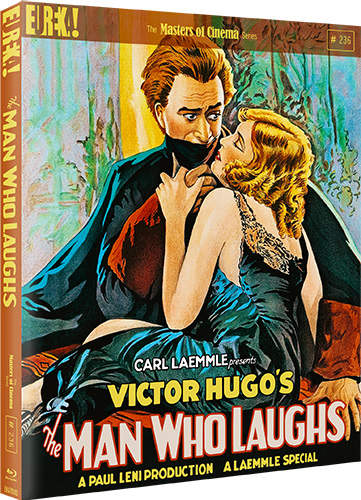
The Man Who Laughs


Released from Eureka Entertainment, this classic silent film garners a new restoration in 4K as a part of the label's ongoing Masters of Cinema series.


Made in 1928, the film was made by Paul Leni famous German Expressionist director from the early 1920s and his cinematographer Gilbert Warrenton who had made The Cat and the Canary (1927). This film is considered an early entry into Universal Studios now famous purple patch of horror movie classics under the stewardship of producer Carl Laemmle. From the studio head down, along with art director Charles Hall and make up guru Jack Pierce this collaboration was married with a defining performance at its centre by Conrad Veidt.

Veidt plays Gwynplaine, a carnival performer whose face is mutilated into a permanent ghoulish grin by his executed father's royal court enemies. Gwynplaine struggles through life with blind Dea (Mary Philbin) as his companion, and despite his disfigurement Gwynplaine still considers himself unworthy of Dea's affection.


The make up on Veidt's role has been acknowledged as direct inspiration for the first portrayal of the Joker in the DC Comics of Batman in 1940 and has become common place in screen portrayals through the years culminating in Heath Ledger's Oscar winning turn in The Dark Knight (2008).


Featuring moments of humour, tragedy, doomed romance and swashbuckling fight scenes, The Man Who Laughs remains as one of the most stylish entries into the American silent cinema era. With the sound era about to burst prominently onto the scene and the monsters of Universal pictures being able to talk come 1930-31 with Bela Lugosi as Dracula and Boris Karloff as Frankenstein's monster; it is wonderful to see the richness and detail within the film's production from costume to sets to narrative construction.

The film has been restored from Universal's 4K transfer to Blu-ray and features a score by the Berklee School of Music along with featurettes by horror expert Kim Newman and a booklet by Travis Crawford and Richard Combs.

The Man Who Laughs is available now on Blu-Ray from Eureka Entertainment

Tuesday, 23 June 2020

Criss Cross


One of the more underrated film noir movies is released by Eureka Entertainment as part of the Masters of Cinema series


Criss Cross was made in 1949 and marked the reunion of sorts of the creative team that had made the 1946 classic The Killers. This is also directed by Robert Siodmak, stars Burt Lancaster with music orchestration by Miklos Rosza.

Criss Cross tells the story of Steve (Lancaster) a man who has moved back to Los Angeles, hoping to move on from a disillusioned marriage to Anna (Yvonne De Carlo) and get back to normality. However, it does not take long for Steve to reconnect with Anna at a former hang out and upon realising she is now the partner of local hoodlum Slim Dundee (Dan Duryea), Steve and Anna begun a torrid affair that may be the end of them.


To cover up the affair, Steve lays a bank heist pan on Dundee where they split the loot 50-50, but the hope being that Steve will double cross Dundee and take all the money and his woman for himself.

Siodmak paints Criss Cross in this familiar battle of light and dark, but also reality and dream like state; Lancaster's drawl of voiceover narration making the audience feel that what they are watching is not merely a tale but unreality - you are never far away from being reminded that this is a film you are watching.  The combative nature of dark trying to ingress upon the natural light spaces is perfectly captured by cinematographer Franz Planer.

Rosza's score is understated also, with dips and troughs of high emotion to subtle sweeps of romance where love can be deadly.

As always in film noir, there is a cynical edge to the narrative and a fatalistic streak to the action; nobody in a true noir can ever be happy and nobody gets away with it.  For all the glamourisation of violence and the appeal of crime, the come uppance is not far away for our protagonists.

Lancaster's screen charm, this coming just three years after his debut in The Killers, shows how quickly he became a star his natural charisma sitting perfectly within the mayhem around him, De Carlo does very well as the femme fatale and she is granted the key speech at the denouement and Duryea is key as the slimy Slim. 

This is such a gripping watch by the film's conclusion culminating in a tense stand-off helped by Siodmak's ability to cast the perfect face to fit the role required.

Criss Cross is out now from Eureka Video.

Monday, 20 April 2020

Rio Grande: Blu-ray review


Eureka Entertainment release RIO GRANDE, the final instalment of the Cavalry Trilogy starring John Wayne directed by John Ford


The last entry of the oft-forgotten 'Cavalry Trilogy' that featured John Wayne and was directed by John Ford; Rio Grande (1950) followed the hits Fort Apache (1948) and She Wore A Yellow Ribbon (1949) and is thought of as the most underrated collaboration between the illustrious pair.

The film marks the end of that trilogy, but also a new beginning to their partnership and the first film that Wayne would appear opposite Maureen O'Hara (The Quiet Man coming in 1952).


Wayne is Lt. Col. Kirby Yorke, attached to the Texas frontier in 1879 to protect settlers from attacks by Apaches. When Yorke's son – a West Point flunkee turned Army private – is assigned to his father's regiment, tensions flare upon the arrival of Yorke's estranged wife Kathleen (O'Hara), who wants their teenaged son out of Yorke's unit. After Apaches attack, the stakes of Yorke's mission escalate, and he must journey to Mexico where the Apaches are hiding out. With his son and two old recruits (Ford/Wayne regulars Ben Johnson and Harry Carey Jr.) as accompaniment, Yorke faces his toughest battle.
This back against the wall mentality comes out through Wayne's impressive lead performance, holding it all together with a strong ensemble around him. This role comes in the midst of a great purple patch of Wayne's iconic roles - in 1948 he played Tom Dunson in Howard Hawks' Red River, the role that prompted Ford to say, 'Damn, I did not know the sonofabitch could act' and in 1956 Wayne would play his most famous role of Ethan Edwards in The Searchers. Wayne was the biggest star in Hollywood stepping between war and western films regularly with great success.
When watching Rio Grande, it is another example of Ford's mastery of scene setting and action sequences - the vistas of Monument Valley provide Ford a virtual playground to enjoy with Wayne his main subject. The character of Kirby having to walk the fine line between a soldier of duty and that new found streak of parenthood that has been thrust upon him in the most stressful of situations.
Highly enjoyable and recommended for all western film aficionados, this is a beautiful 4K restoration on Blu-ray. 
The features include a video essay by Tag Gallagher, archival documentary featuring Maureen O'Hara with specific audio commentary also and a feature-length audio commentary by Stephen Prince.
Rio Grande is out now from Eureka as part of their Masters of Cinema series.
My thanks to them for the review opportunity.

Tuesday, 31 March 2020

Buster Keaton: 3 Films (Volume 2)


Eureka Video continue their stupendous work of essential silent films, releasing their second volume of Buster Keaton gems in a three-film volume pack.


Between 1920 and 1929, Buster Keaton created a peerless run of feature films that established him as “arguably the greatest actor-director in the history of the movies”. Collected here are three further films from that era; The Navigator, Seven Chances and Battling Butler. The Masters of Cinema Series is proud to present all three films from stunning 4K restorations in their UK debuts on Blu-ray.

The Navigator (1924, dir. Buster Keaton & Donald Crisp) – Wealthy Rollo Treadway (Keaton) suddenly decides to propose to his neighbour across the street, Betsy O'Brien (Kathryn McGuire), and sends his servant to book passage for a honeymoon sea cruise to Honolulu. When Betsy rejects his sudden offer however, he decides to go on the trip anyway, boarding without delay that night. Because the pier number is partially covered, he ends up on the wrong ship, the Navigator, which Betsy's rich father has just sold to a small country at war. Keaton was unhappy with the audience response to Sherlock Jr., and endeavoured to make a follow-up that was both exciting and successful. The result was the biggest hit of Keaton's career.  

Seven Chances (1925, dir. Buster Keaton) – Jimmy Shannon (Keaton) learns he is to inherit seven million dollars, with a catch. He will only get the money if he is married by 7pm on his 27th birthday, which happens to be that same day! What follows is an incredible series of escalating set-pieces that could only have come from the genius of Buster Keaton. 

Battling Butler
(1926, dir. Buster Keaton) – A rich, spoiled dandy (Keaton) pretends to be a champion boxer, "Battling Butler", to impress the family of the girl he loves. When the real Butler shows up, he decided to humiliate the imposter by having him fight the "Alabama Murderer”!


While Keaton is perhaps lauded in equal measure of his peer, Charlie Chaplin, at the time he was not as commercially successful, to think that something like Sherlock Jr. did not strike a chord with the film-going public, whereas Chaplin could dance with potatoes and have them rolling in laughter.

Whereas, Chaplin would do things you have never seen before and perhaps be based more in the realms of disbelief, Keaton was more of the everyday comedian taking moments of domesticity and turning them on their head such as the making of food in The Navigator, his character is a toff and has no idea how to open tinned foods making for hilarious results.

While Chaplin would marvel you with his performance and pin-point detail, Keaton's films are more indebted to the plot and narrative, how a character overcomes an obstacle with the situation playing out over a script while Chaplin would have stand along set pieces away from the central plot. Not to say Keaton does not have his moments, but the set-piece comes as a gradual build up to such a key moment; this is helped by his iconic stone face persona granting no reaction or change of perception.

Keaton also has this realistic mentality in his work, not a lot of good fortune befalls his protagonists until the eventual happy resolution, bad luck seemingly follows him wherever he goes but he struggles through it all gamely, while Chaplin would smile and move on to the next disaster zone of his own making more than likely.

Keaton's influence is unparalleled and perhaps has lasted longer than Chaplin, his work has very much had a say in the work of Wes Anderson; the set pieces and the nature of performance particularly can be seen in Ralph Fiennes role in The Grand Budapest Hotel in terms of physicality and tonality of that film in general.

Buster Keaton: 3 Films (Volume 2) is out now from Eureka Video in a Limited Edition 60-page Perfect Bound Collector’s Book and Limited Edition Hardbound Slipcase [3000 copies ONLY].

My thanks to them for the review opportunity

Wednesday, 19 November 2014

The Thief Of Baghdad

As part of the continuing Masters of Cinema series from Eureka Video, The Thief of Baghdad is released on a special Blu-ray edition and brings to the small screen in a new print one of the great films in the career of the hugely admired Douglas Fairbanks.


Directed by Raoul Walsh, but produced by the highly independent Fairbanks, Thief tells the story of Ahmed (Fairbanks) who encounters danger and adventure in equal measure in a purely studio based film.  Featuring ahead of its time special effects such as the famous climatic flying carpet ride, the film is indicative of one man's vision. In stark contrast to the stringent Hollywood studio system that was still 10 years away from its heyday, this was a film full of invention and imagination.

We are still ten years from Capra's coming out party with It Happened One Night, 15 years from John Ford's Stagecoach in 1939, the same year as Hitchock's final UK film before he came to America in 1940 under David O. Selznick to make Rebecca. In the mid 1920s three years before the advent of sound in cinema, the art form was following theatre by making the actor the star.  The stars knowing this wanted more creative control of their final product.

Fairbanks was a contemporary of the other two Hollywood darlings of the mid to late 1920s, Mary Pickford and Charlie Chaplin. The three of them helped form United Artists; the independent production company that allowed the three stars to make what films they wanted and give them the power to produce and in Chaplin's case ultimately direct.  It gave them the freedom to pursue artistic endeavours of their own volition.

In Fairbanks case it was a chance to do something of this scale, a film with vastness of a Cecil B. DeMille film but with the imagination of Melieres whilst embracing a key central performance by the featured actor.  In a way you could say Thief is the first actor led film who was not reliant upon the name of a director be it Griffith/Lubitsch above the title.


If that's the case the Thief of Baghdad is an amazing Hollywood product - larger than life, fantastical, amazing and hugely entertaining. The reason a silent cinema featuring the problem of a white man play a Muslim is accepted due to the sheer photogenic presence of Fairbanks himself. Like his contemporary Chaplin, there is a magnetism about his performance the way he moves and does his own stunts all with a charm burning from his shirtless torso and a smile beaming from whiter than white teeth set against the vast production and set design.

While the case this could be made as an actor's auteur film, the work of Walsh who would go on to direct such classic Hollywood fare as High Sierra and White Heat, should not be ignored. Coming to the set as a somewhat novice, this was his first major production and he does a great service to the film by keeping the tempo and tone throughout the work.

From shimmering up a rope out of a basket to the carpet ride, there are thrills and spills a plenty in this brisk 140 minute running time. It would be a great introduction for many to the joys of silent cinema, helped by the sprightly new score by Carl Davis and the London Philharmonic Orchestra. The dual format Blu-ray/DVD edition has an accompanying 40 page booklet by Laura Boyes from the North Carolina Museum of Art.

The Thief of Baghdad will be released on Blu-ray/DVD dual format on Monday 24th November at £14.99 rrp

www.eurekavideo.co.uk

Monday, 31 March 2014

White Dog

In continuation of their fine Masters of Cinema series, Eureka Video is releasing Samuel Fuller's forgotten controversial title White Dog on DVD and Blu-ray on Monday 31st March.

Fuller's film from 1980 tells the story of a white dog who when taken in by a would-be Hollywood starlet Julie Sawyer (Kristy McNichol) after hitting him one night, realises that her new best friend only seems to like people of a certain skin colour.  The dog is called a white dog (despite its white Alsatian breeding) because it has been trained to bark, sneer and even kill black people.

Julie takes the dog to a specialist trainer called Keys (Paul Winfield), himself a black man who attempts to train the racism out of the dog through aversion therapy and feeding it hamburgers from his black hand.

There are obstacles as with any psychological evaluation, one jail break from the dog one night results in him chasing a black man and killing him in a church.  The symbolism was never lost on Fuller.  Yet we never see the full bloody gore of the attack, the barking and biting is all done in the edit, and Winfield conveys the full horror of the assault through his look alone.  Fuller holds on Keys when he comes across the body in the church and in a long take, allows Winfield to show us the horror in his eyes.

Winfield a stalwart of American prime-time television throughout the 1980s and 90s was one of those amazing well-spoken black actors of this era along with James Earl Jones, Billy Dee Williams and Carl Weathers; all men of integrity and intelligence without resorting to physical domination in mark contrast to say Arnold Schwarzenegger and Sylvester Stallone.

Fuller who wrote the screenplay with a young Curtis Hanson (LA Confidential), made a taut and tight thriller that is small on exposition but helped by a stellar cast who do a lot with limited roles and create a world of fear and the unknown due to the odd nature of the canine attacker.

The film was vilified upon completion and not granted a release due to the supposed sensationalist nature of the material and a NAACP fear that the film would stoke up racist violence and allow racists to train racist dogs.  The film was essentially shelved and following the upheaval surrounding the two and four hour cuts of his World War Two opus The Big Red One (1980), Fuller was all but done in Hollywood.

The film is not racist but instead an exploration of the creation of racism and the handling of it.  The story is about a white girl who seeks help from a black man.  Told with the thrilling use of close-ups on McNichol to convey her fear and worry, and editing expertly to convey the rage within the white dog of the title.

Ripe for a re-appraisal from one of the unheralded masters of American cinema, White Dog is a brilliant evocation of racism and psychology dealt with intelligence and finesse.

White Dog is out on Blu-Ray and DVD from Eureka Video on Monday 31st March

Watch a trailer of White Dog here

Tuesday, 26 July 2011

A High Wind in Jamaica - DVD Review

Eureka Entertainment return with a fine Pirate picture from 1965 that has been lost to time and is in much need of reappraisal.

Based upon Richard Hughes' classic 1929 novel, Alexander Mackendrick (Sweet Smell of Success, The Ladykillers) adapts to give a high seas adventure with something for all the family.

Featuring two big stars - Anthony Quinn and James Coburn - and wonderful turns from the young child actors, the film much in the tradition of those rip-roaring pirate films of your youth (numerous Treasure Island adaptations, Mutiny on the Bounty), filmed on location and with excellent prodcution values. 

Pirate movies are like the modern day space films, once they hit dry land you yearn for the seafaring stuff; think of it as akin to Avatar.  The film is all the less once it hits the 2D universe, you want to see more of Pandora and be whisked away. 

Three children are being sailed back to schooling in England during the 1870s, however, once the ship is attacked by pirates led by their captain Chavez (Quinn), the children accidentally end up on the ship they have commandered.  This leads to tension between Chavez and his fractitious crew led by his first mate Zac (Coburn), who believe the presence of children can lead to trouble if old sea-hand superstitions are to be believed.

The film cleverly evokes a time of childhood and how important the role of adults in the development of perception is; the pirates learn to break down the harshness of themselves once the children embrace their different way of life.  Life lessons are learnt by both parties, even though it will end with the parties separated.

The DVD is out now from Eureka in a new HD transfer in the correct 2.35:1 ration, the features include a UK and US trailer, and English subtitles for the deaf and hearing impaired.

http://www.eurekavideo.co.uk/
Twitter: @mastersofcinema and @steve_hills