Showing posts with label Western. Show all posts

Monday, 20 April 2020

Rio Grande: Blu-ray review


Eureka Entertainment release RIO GRANDE, the final instalment of the Cavalry Trilogy starring John Wayne directed by John Ford


The last entry of the oft-forgotten 'Cavalry Trilogy' that featured John Wayne and was directed by John Ford; Rio Grande (1950) followed the hits Fort Apache (1948) and She Wore A Yellow Ribbon (1949) and is thought of as the most underrated collaboration between the illustrious pair.

The film marks the end of that trilogy, but also a new beginning to their partnership and the first film that Wayne would appear opposite Maureen O'Hara (The Quiet Man coming in 1952).


Wayne is Lt. Col. Kirby Yorke, attached to the Texas frontier in 1879 to protect settlers from attacks by Apaches. When Yorke's son – a West Point flunkee turned Army private – is assigned to his father's regiment, tensions flare upon the arrival of Yorke's estranged wife Kathleen (O'Hara), who wants their teenaged son out of Yorke's unit. After Apaches attack, the stakes of Yorke's mission escalate, and he must journey to Mexico where the Apaches are hiding out. With his son and two old recruits (Ford/Wayne regulars Ben Johnson and Harry Carey Jr.) as accompaniment, Yorke faces his toughest battle.
This back against the wall mentality comes out through Wayne's impressive lead performance, holding it all together with a strong ensemble around him. This role comes in the midst of a great purple patch of Wayne's iconic roles - in 1948 he played Tom Dunson in Howard Hawks' Red River, the role that prompted Ford to say, 'Damn, I did not know the sonofabitch could act' and in 1956 Wayne would play his most famous role of Ethan Edwards in The Searchers. Wayne was the biggest star in Hollywood stepping between war and western films regularly with great success.
When watching Rio Grande, it is another example of Ford's mastery of scene setting and action sequences - the vistas of Monument Valley provide Ford a virtual playground to enjoy with Wayne his main subject. The character of Kirby having to walk the fine line between a soldier of duty and that new found streak of parenthood that has been thrust upon him in the most stressful of situations.
Highly enjoyable and recommended for all western film aficionados, this is a beautiful 4K restoration on Blu-ray. 
The features include a video essay by Tag Gallagher, archival documentary featuring Maureen O'Hara with specific audio commentary also and a feature-length audio commentary by Stephen Prince.
Rio Grande is out now from Eureka as part of their Masters of Cinema series.
My thanks to them for the review opportunity.

Wednesday, 25 October 2017

Wayne and Ford


35048738

Released from Doubleday Books, Nancy Schoenberger looks deep into the life-long career relationship between two titans of the 20th Century cinema landscape, who are both synonymous with that most American of film genres - John Wayne and John Ford - who forever will be the cowboy and the man who shot him.

The book covers all of their careers but touching base especially on the landmark films such as Stagecoach (1939), Fort Apache (1942), The Quiet Man (1952) and The Searchers (1956).  Whilst Ford showed versatility throughout his filmography, he himself in later life succumb to the public opinion, 'I'm John Ford. I make westerns' mindset.

John Wayne for years worked in B-movie pictures before getting cast as the Ringo Kid in 1939's Stagecoach, a film that would be the making of his mythic status as the archetypal western hero. Stagecoach was the start of the Western film as we know it; the clearer boundary of good versus evil, the east intruding upon the west and the use of Monument Valley as the key backdrop for action.

Ford made Westerns without Wayne, and yet they did not match the illustrious status of those collaborations yet Wayne made Red River with Howard Hawks and won his only Oscar for True Grit in 1969, a throwaway role and film.

The book goes into the background of Ford, a heavy drinker between films who lived in a loveless marriage and due to his Catholic upbringing could not divorce, who harboured romantic feelings for Katherine Hepburn and suppressed homosexual yearnings for years.  Ford was a complex figure who found salvation in his work during the Second World War working with the Navy, whilst Wayne that most emblematic figure of masculinity and manhood chose to stay at home during the conflict whilst Ford and Wayne's contemporaries, James Stewart and Henry Fonda engaged in combat.

That difference of role during the early 1940s led to arguments between the men, as did Wayne's political beliefs for the Republican party.  Whilst Ford used his demons to make great work and found solace in the unity of a film crew and team, Wayne became the star of the industry that made him and shied away from moral responsibility at the behest of personal fortune.  Wayne attempted to direct his great picture in The Alamo, a film that nearly bankrupt him and became forgotten and a laughing stock.

The film skates over some films in parts which is unfortunate and should not be thought of as a book of film criticism but nevertheless does do credit to a great chapter in American film history with these two figureheads standing tall above them all.


Thursday, 7 August 2014

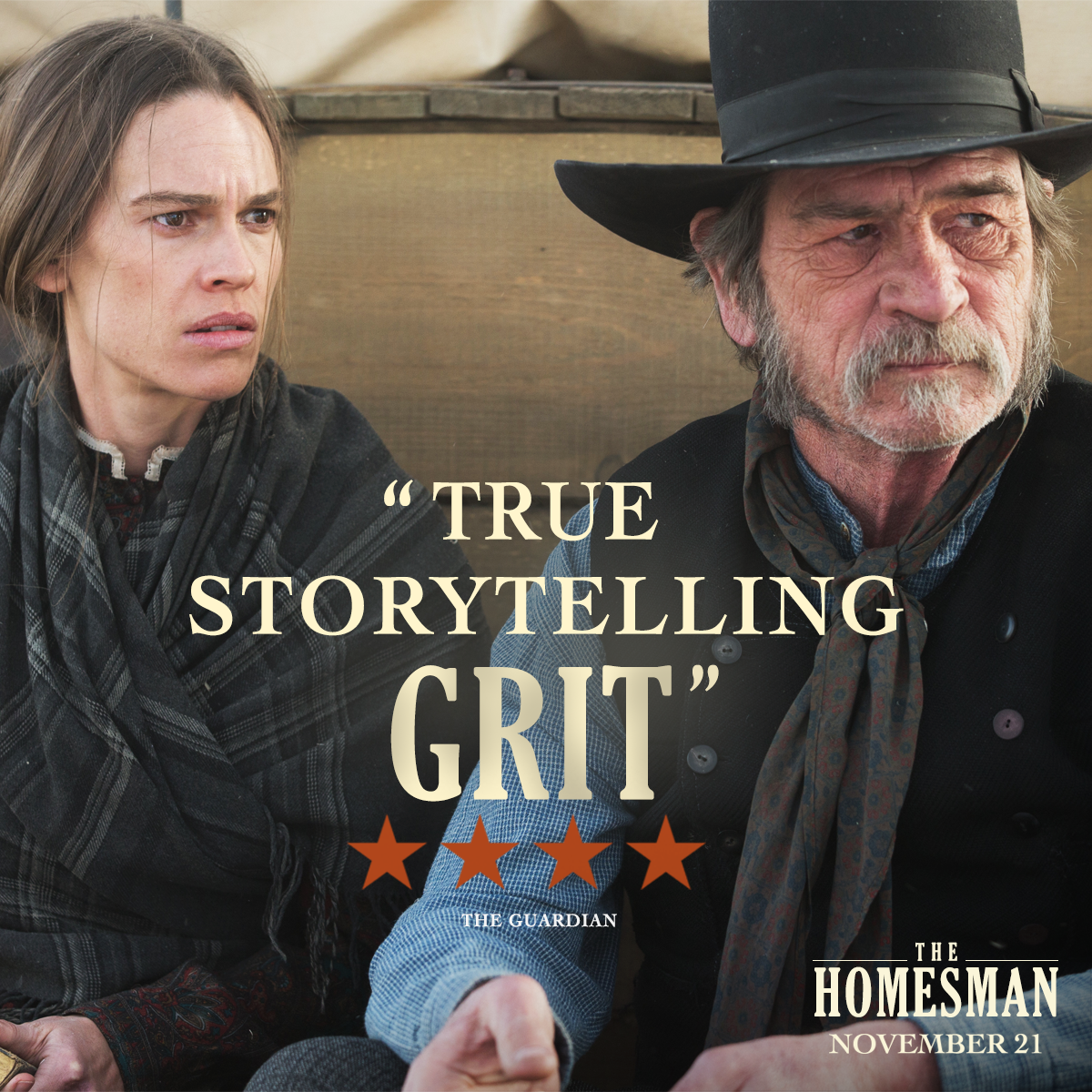
The Homesman - Preview

Embedded image permalink

Tommy Lee Jones, one of the finest and most consistent actors in America, returns to the screen but also goes back behind the camera for his sophomore effort, The Homesman, following the critical success of The Three Burials of Melquaides Estrada.

Entertainment One released the trailer for the film this morning (7th August) before the scheduled 21st November release.

https://www.youtube.com/watch?v=b5Hh1thDeAU&list=UU3GIDBVwW7-E2lQrIUiHeYA

The film stars Jones as George Briggs, a man about to hang himself when he is saved by the independent Mary Bee Cuddy, portrayed by Hilary Swank.  For saving his life, Cuddy convinces Briggs to help her escort three crazy women across country. Set in the American West of the 1850s, this is a western film based on the synonymous novel by Glendon Swarthout.

The trailer shows us plenty of action and gives us glimpses of other fine talent in the film including John Lithgow, Tim Blake Nelson and Meryl Streep.  Tellingly, we do not get much of a look of the three troubled women, although they appear to be played by unknown actresses.  The trailer concentrates on the dynamic relationship between Briggs and Cuddy, with Swank ending the clip on the upbeat note, 'We make a good team you and me'.

In cinematic terms, the film carries the same sinister and underlying darkness that was in Jones' directorial debut; and yet the pictures harken back to a time of late era Sam Peckinpah and Don Siegel.  We can be assured though that the acting will be first rate.

Like the Facebook page: https://www.facebook.com/HomesmanUK
Follow on Twitter: https://twitter.com/HomesmanUK

Follow me on Twitter @NextToTheAisle

Monday, 20 June 2011

Faccia a Faccia (Face to Face) - DVD review


The western genre is full of law and order versus chaos and violence; stand offs between two men who hold opposing virtues in equal measure and consider their respective cause as worthy enough to fight for.  In most cases, the sheriff who wants to uphold the sanctity of peace and goodwill in his far flung town, and the six-shooter who wants to get everything he wants through violence at any cost to human life. 

This exciting new re-released Spaghetti western flips the ideas of law and order, right and wrong, order and chaos and the identity of the good guy in westerns on its head.

Faccia a Faccia, is directed by Sergio Sollima (The Big Gundown) and tells the story of a retiring professor Brad Fletcher (Gian Maria Volante) who due to his poor health moves west for warmer climate.  As soon as he arrives, he is taken hostage by the bandit Bennett (Tomas Milian) and has to live with the gang. 

After initial reluctance, he finds a calling amongst his fellow criminal cohorts, taking to crime and thuggery with ease.  This leads to Fletcher overthrowing Bennett and initiating a crueller system of leadership instead, so in essence a standoff between two villains forms the central relationship and conflict of this film; the generic modification being that the more evil villain of the two was once a learned man.

I can see initial similarity to John Ford's The Man Who Shot Liberty Valance, where James Stewart's character Rance Stoddard when also moving west from the east attempts to incorporate his learned skills of knowledge upon the illiterate townsfolk with limited success.   
             Much like Fletcher, Stoddard is assaulted by Liberty Valance (Lee Marvin) on his first night in town and as John Wayne's Tom Doniphon explains to Stoddard - you have to fight fire with fire, and as much as Stoddard wants Valance put behind bars, violence is the only solution to a mind like Valance.  And so the famous conclusion with the realisation, and the memorable, 'when the myth becomes fact, print the myth' holds greater sway as Stoddard is now an elected Senator on the back of his feat of being said man.

The new print format on this DVD release from Eureka! entertainment features stunning cinematography in glorious Techniscope and a thrilling orchestral score from the renowned Ennio Morricone. 

The pictures and the framing of the action in this Texas landscape is helped by the ruthless and convincing performances by the esteemed cast.  Spaghetti westerns (western genre pictures produced in Italy) were made famous by Sergio Leone's Dollars (1964-66) trilogy featuring Clint Eastwood in the mid-1960s and this production made in 1967 is symptomatic of those thrilling films, retaining the same zest for excitement and thrill seeking.

Not to do a discredit this picture, it does convincingly portray a picture what the cruelty and ruthless west must have been like - the dynamic relationship between the learned Fletcher and outlaw Bennett, and how cleverly the educated man from the east attempts to takeover the man of the west, can be interpreted as a comment on imperialism which coming from a European viewpoint is both tantalising and alternatively creative.

However, as the western genre lives on mythologising men to epic status above their station as sheep herders and cattle ranchers; so this authentic slice of stylish 1960s Italian cinema, this film is ripe for reappraisal and should be allowed to create its own myths.

The DVD contains the original Italian audio with new English subtitles, and new Technicolour print; US and Italian theatrical trailers; an interview with director Sergio Sollima, a lavish 16 page booklet containing a new essay by spaghetti western expert Howard Hughes.

Available from Eureka! on Monday 20th June on both Blu-Ray and DVD